AI estimate as of October 5, 2025 · verify with a professional before acting
AI-Generated · Verify before acting
Everything on this page is generated by AI for informational purposes only. AI can make mistakes — the AI may misidentify items or misattribute them (artist, maker, brand, designer, origin, era). This is not an official valuation and should not be used for insurance, sale, tax, estate, legal, or lending purposes — or any decision requiring a certified appraisal. It is not an authoritative claim about any person, brand, or rights holder — do not share or rely on it as a factual statement about a third party. Always consult qualified professionals before making financial decisions.
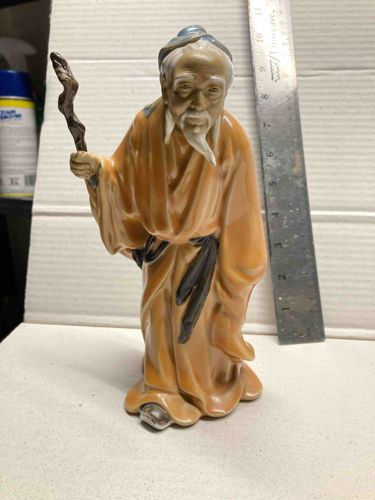
This item is a ceramic or porcelain figurine depicting an elderly wise man or scholar, possibly a 'Shou Lao' figure, standing and holding a gnarled staff. The figure is rendered with great attention to detail in the facial features, including a long, flowing white beard and mustache, along with white eyebrows. He wears a traditional robe, predominantly in a warm, glossy caramel-brown or light orange glaze. Over his left shoulder, there are hints of a lighter blue or grey garment, and a dark brown or black sash is visible near his waist, contrasting with the main robe. His hair, visible at the back, appears to be slicked back and subtly colored blue-grey under a small cap. The skin tone of the face and hands is a naturalistic light beige. The staff he holds is brown, resembling wood, with a twisted, knotty texture. The base of the figurine is integrated with the flowing robes, showing the tips of his footwear in a silvery-grey tone. The craftsmanship appears to be of good quality, with smooth glazing and definition in the sculptured elements. No visible cracks, chips, or significant wear are immediately apparent from the provided image, suggesting good overall condition. There are no discernible manufacturer's marks or signatures visible. Based on the style and subject matter, this figurine likely dates from the mid-20th century to contemporary times, reflecting traditional East Asian sculptural arts. Its approximate height can be estimated by comparison to the ruler placed next to it, appearing to be around 7-8 inches tall.
AI Appraisal Report
I have visually examined this ceramic or porcelain figurine depicting a wise man or scholar, consistent with a 'Shou Lao' figure. The craftsmanship appears competent, with good attention to facial details including the flowing white beard and individualized features. The glazing is smooth, with a warm caramel-brown main robe and hints of blue-grey on an undergarment. The overall condition appears to be good, with no visible chips, cracks, or significant wear from the image provided. This suggests careful handling. Stylistically, it aligns with East Asian decorative arts, likely from the mid-20th century to contemporary production. Its estimated height is around 7-8 inches.
In terms of market conditions, similar decorative ceramic elder or scholar figurines are relatively common. While this piece shows decent detail, without a discernible maker's mark or specific artistic attribution, it falls into a broad category of imported decorative items. Demand for this type of general decorative figurine is steady but not exceptionally high for pieces lacking unique artistic merit or significant age. Its rarity is low given the mass production capabilities of the period. Factors impacting its value negatively include the lack of specific provenance, a known artist, or historical significance.
Authenticity verification from images alone is limited. A physical examination would be crucial to accurately assess the material (ceramic vs. porcelain), quality of the glaze, and the method of manufacture (hand-potted vs. molded). I would also look for any hidden marks or signatures, assess the weight, and check for repairs not visible in photographs. Provenance documentation, if available, could significantly enhance its value by confirming its origin and history. Without these, the value remains in the decorative arts category rather than as a collectible antique.