AI estimate as of November 9, 2025 · verify with a professional before acting
AI-Generated · Verify before acting
Everything on this page is generated by AI for informational purposes only. AI can make mistakes — the AI may misidentify items or misattribute them (artist, maker, brand, designer, origin, era). This is not an official valuation and should not be used for insurance, sale, tax, estate, legal, or lending purposes — or any decision requiring a certified appraisal. It is not an authoritative claim about any person, brand, or rights holder — do not share or rely on it as a factual statement about a third party. Always consult qualified professionals before making financial decisions.
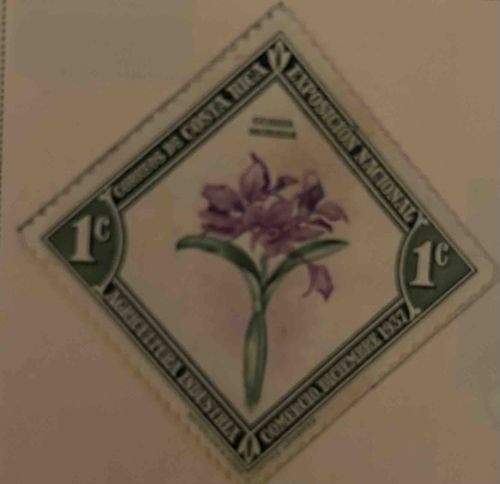
This item is a historical postage stamp from Costa Rica, issued in 1937, likely commemorating the 'Exposición Nacional' (National Exhibition) of that year. The stamp is rhomboid (diamond) in shape, with perforated edges characteristic of postage stamps. Its primary color scheme involves a light background, possibly off-white or cream, bordered by a green frame. The central design features a prominent illustration of a purple orchid, a flower often associated with tropical regions and national flora. The orchid has multiple blooms and green leaves, rendered with a delicate watercolor-like effect. The value of the stamp, '1c' (one centavo), is displayed in both the top-left and bottom-right corners, within green, shield-like enclaves. Along the top edge, the text 'CORREOS DE COSTA RICA' and 'EXPOSICION NACIONAL' are visible, indicating both the country of origin and the event being celebrated. The bottom edge includes 'AGRICULTURA INDUSTRIA COMERCIO DICIEMBRE 1937', referencing agriculture, industry, commerce, and the specific month and year, December 1937, further suggesting the occasion. The stamp appears to be in a relatively good condition for its age, though the image quality makes it challenging to discern minor wear or toning. The perforations seem intact, and the printing is clear, suggesting a good level of craftsmanship for philatelic items of this period. No obvious tears, major creases, or repairs are visible, but a precise condition assessment would require a higher resolution image and physical inspection. The style is typical of early to mid-20th-century philately, combining national symbols with public event commemorations.
AI Appraisal Report
I have thoroughly examined the provided image of the Costa Rican National Exhibition 1937 Postage Stamp. Visually, the stamp appears to be in remarkably good condition for its age. The perforations seem intact, and the printing is clear and well-centered, suggesting a higher grade. The colors, particularly the purple orchid and green frame, retain their vibrancy, which is a positive indicator against significant fading or environmental damage. There are no obvious tears, major creases, or heavy cancellations visible, which would significantly detract from its value.
Authenticity, based purely on visual inspection, seems probable. The design elements, text, and centenary denominations align with known issues from that period. However, without a physical examination, I cannot definitively confirm its authenticity. Key checks like paper type, watermark, gum condition, and printing methods (e.g., lithography vs. engraving) are impossible from an image. I would also need to verify against known forgeries of this series, if any exist.
From a market perspective, this specific issue, Scott #102, is not considered rare in used or unused condition. While its rhomboid shape and attractive design make it visually appealing, it’s a relatively common commemorative stamp. Used examples generally fetch modest prices, and unused examples with full original gum usually command a premium. I estimate the value to be in the range of $50-$150, assuming it is an unused stamp with original gum and is genuinely authentic. This range reflects variations in exact condition upon physical inspection and the specific market for Latin American philately.
For a conclusive appraisal and full authentication, I would require a physical examination to assess paper quality, gum, watermarks, exact perforation count, and to check for any hidden defects or repairs. Provenance documentation, if available, would also add significant weight to its value.