These notes were written by the person who submitted this item. Appraiser.AI has not verified them, and the AI's identification and estimate may rely on them.
AI Estimated Value
Not an official valuation
$1,800 - $2,500
AI estimate as of July 13, 2025 · verify with a professional before acting
AI-Generated · Verify before acting
Everything on this page is generated by AI for informational purposes only. AI can make mistakes — the AI may misidentify items or misattribute them (artist, maker, brand, designer, origin, era). This is not an official valuation and should not be used for insurance, sale, tax, estate, legal, or lending purposes — or any decision requiring a certified appraisal. It is not an authoritative claim about any person, brand, or rights holder — do not share or rely on it as a factual statement about a third party. Always consult qualified professionals before making financial decisions.
This analysis also relies on unverified notes provided by the user, which may be incomplete or inaccurate and could affect the result.
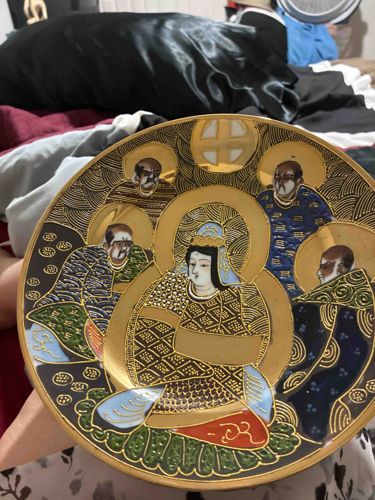
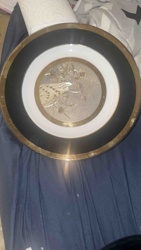
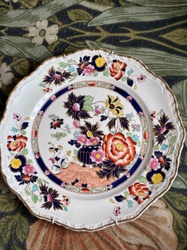
This item is a Japanese porcelain decorative plate, likely from the Satmusa tradition, characterized by its richly detailed and gilded design. The plate features a central figure, appearing to be an empress or deity, distinguished by a light complexion, dark hair, and an intricate blue and gold headpiece. She is seated with her hands clasped, wearing robes adorned with detailed patterns in gold, black, and light blue. Surrounding the central figure are five smaller, seated male figures, possibly attendants or disciples, depicted with darker skin tones and wearing robes in various shades of blue, green, and black, also embellished with gold details. Each of these figures, including the main one, is encircled by a golden halo, indicating their significant status. One additional, distinctively shaped motif, possibly a symbolic emblem, is present at the top of the plate, also outlined in gold.
The entire surface of the plate is heavily gilded, creating a striking contrast with the vibrant enamel colors used for the figures' garments and skin tones. The background features a finely executed, repetitive pattern of swirling lines and dots, all in gold against a dark underlying surface, giving the impression of waves or clouds. The craftsmanship demonstrates a high level of detail and precision in the application of both gold and polychrome enamels. The plate appears to be in good condition with a visible luster, suggesting minimal wear to the gilding and enamels. There are no immediately obvious chips, cracks, or significant abrasions. The quality of the hand-painting and the extensive use of gold indicate a piece intended for decorative display rather than everyday use, characteristic of Satsuma ware. The style suggests a Meiji period (1868-1912) influence or later, given the detailed figural work and the specific use of heavy gilding.
AI Appraisal Report
Based on my visual examination of the provided image, this Satsuma-style Japanese porcelain plate displays exceptional decorative quality. The intricate detail in the figural work, the extensive and precise gilding, and the vibrant enamel colors are hallmarks of high-quality Satsuma ware. The condition appears to be very good; I observe excellent luster, minimal wear to the gilding, and no obvious chips, cracks, or significant abrasions from the image. This suggests it has been well-preserved, consistent with its likely purpose as a decorative item rather than utilitarian use. The detailed craftsmanship and heavy gilding point towards a Meiji Period (1868-1912) origin, which is a highly desirable era for Satsuma. \n\nThe market for fine Japanese decorative arts, particularly well-preserved Satsuma pieces from the Meiji period, remains robust. Comparables would include other highly decorated Satsuma plates or chargers with similar elaborate figural scenes and extensive gilding, which consistently fetch strong prices at auction and through reputable dealers. Demand for such pieces is generally high among collectors of Asian art and decorative porcelain, driven by their aesthetic appeal and historical significance. Rarity is also a factor, as pieces in this condition with such detailed artistry are becoming less common.\n\nLimitations in authentication primarily stem from relying solely on images. While the style strongly suggests genuine Satsuma from the Meiji period, an in-person examination would be crucial to verify the tactile quality of the porcelain, the application of enamels and gilding (e.g., raised enamels, specific crackle patterns), and to check for any hidden repairs or restorations not visible in photographs. Furthermore, the presence of a maker's mark or artist's signature on the reverse, which is not visible here, would significantly aid in precise identification and can impact value. Provenance documentation, if available, would also provide invaluable authentication and historical context. Without these, the assessment of authenticity is based on typical visual characteristics alone.