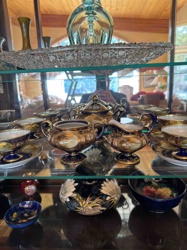
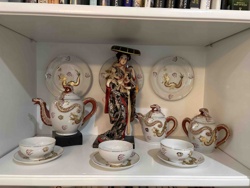
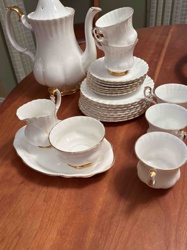
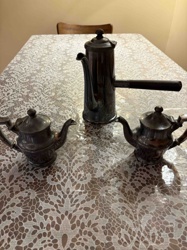
These notes were written by the person who submitted this item. Appraiser.AI has not verified them, and the AI's identification and estimate may rely on them.
AI Estimated Value
Not an official valuation
$40-60
AI estimate as of September 6, 2025 · verify with a professional before acting
AI-Generated · Verify before acting
Everything on this page is generated by AI for informational purposes only. AI can make mistakes — the AI may misidentify items or misattribute them (artist, maker, brand, designer, origin, era). This is not an official valuation and should not be used for insurance, sale, tax, estate, legal, or lending purposes — or any decision requiring a certified appraisal. It is not an authoritative claim about any person, brand, or rights holder — do not share or rely on it as a factual statement about a third party. Always consult qualified professionals before making financial decisions.
This analysis also relies on unverified notes provided by the user, which may be incomplete or inaccurate and could affect the result.
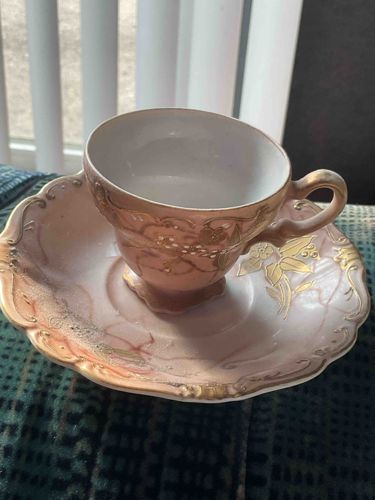
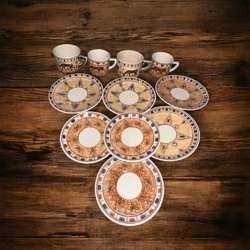
This is a beautiful vintage tea cup and saucer set featuring a unique marbled pink and gold design, consistent with Shofu china. The set is crafted from porcelain, with the primary color scheme being a soft, muted pink base, heavily accented with rich, shimmering gold detailing. The marbling effect on both the cup and saucer gives the surface a variegated appearance, with lighter and darker swirling patterns of pink, interspersed with occasional hints of a paler, almost off-white hue. The cup has a classic, slightly flared rim and a delicate, C-shaped handle, also highlighted with gold. The exterior of the cup and the inner surface of the saucer are adorned with intricate hand-painted floral or botanical motifs rendered in raised gold paste, showing fine craftsmanship. These designs appear to depict leaves, vines, and possibly small berries or flowers. The saucer is not perfectly round; it has a scalloped or undulating rim, further embellished with a heavily applied gold border, which shows some texture and depth. There is visible wear to some of the gold accents, particularly on the rim of the saucer where some of the gilding has rubbed off, indicating age and use. Small specks or very minor abrasions may also be present on the pink marbled surface, consistent with vintage porcelain. The inner surface of the cup is a clean, uniform off-white porcelain, providing a stark contrast to the ornate exterior. The overall impression is one of delicate elegance and refined artistry, typical of early to mid-20th-century Japanese export porcelain, especially from known manufacturers like Shofu.
AI Appraisal Report
Upon examination of the provided images, this tea cup and saucer set exhibits characteristics consistent with Shofu porcelain from the early to mid-20th century. The attribution is based on the distinctive marbled pink and gold design, the hand-painted raised gold detailing, and the overall form of the cup and scalloped saucer. Based on the visual evidence, the piece appears to be authentic Shofu ware. Its condition is fair to good for its age, showing visible wear to the gilding, especially on the saucer's rim, and minor surface abrasions as noted. This wear is a significant factor in determining its value.
Currently, the market for individual Japanese export porcelain tea sets like this one is relatively soft. While aesthetically pleasing, they are not exceptionally rare. Comparable Shofu marbled sets in similar condition, showing some wear, typically sell in the secondary market for between $40 and $60. Sets in mint condition or with more elaborate, pristine decoration can command higher prices. The hand-painted nature adds to its appeal, but the wear detracts from its value for serious collectors who often prioritize condition.
It is important to note the limitations of an appraisal based solely on images. A definitive authentication was not possible. For full verification, an in-person examination would be required to inspect for a maker's mark on the underside, which is crucial for confirming the Shofu attribution. Additionally, physical handling would allow for a more thorough assessment of the porcelain quality, the integrity of the raised enamel, and any potential hidden damages or repairs not visible in the photographs.