AI estimate as of November 12, 2025 · verify with a professional before acting
AI-Generated · Verify before acting
Everything on this page is generated by AI for informational purposes only. AI can make mistakes — the AI may misidentify items or misattribute them (artist, maker, brand, designer, origin, era). This is not an official valuation and should not be used for insurance, sale, tax, estate, legal, or lending purposes — or any decision requiring a certified appraisal. It is not an authoritative claim about any person, brand, or rights holder — do not share or rely on it as a factual statement about a third party. Always consult qualified professionals before making financial decisions.
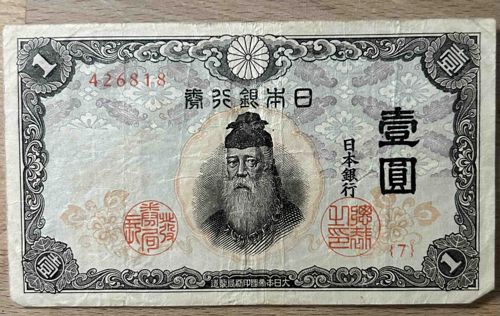
This is a Japanese 1 Yen banknote, likely from the Series A issue, initially released starting in 1943 and circulated until 1946. The banknote features a vertical portrait of Takenouchi no Sukune, a legendary figure in Japanese history, prominently displayed in the center. He is depicted as an elderly man with a long, flowing beard and a traditional head covering, rendered in black and white etching with fine detail. The dominant colors of the banknote are light brown, beige, and white, with intricate patterns in green, red, and black inks. The top center features the Imperial Seal of Japan (kikumon) with eighteen petals, a symbol of the Japanese emperor and state. To the left of the portrait, the serial number '426818' is printed in red. Various Japanese characters (Kanji), including '日本銀行' (Nippon Ginko - Bank of Japan) and '壹圓' (ichi en - one yen), are visible. The four corners of the banknote feature the numeral '1' enclosed in an ornate frame, consistent with the denomination. Decorative borders with swirling patterns and floral motifs surround the central design and frame the entire banknote. There are also red circular or square seals with Japanese characters, indicating official markings or signatures of bank officials. The paper shows signs of circulation, including creases, folds, and a slight yellowing or discoloration, particularly around the edges and folds, suggesting age and handling. The overall condition appears to be 'Fine' to 'Very Fine' given the visible wear but absence of major tears or holes. The printing quality is good, indicating standard government-issued currency craftsmanship.
AI Appraisal Report
I have carefully examined the provided image of the Japanese 1 Yen Banknote (Series A, 1943-1946 Issue). Based on the visual evidence, the banknote appears authentic and consistent with known examples of this issue. The design elements, including the portrait of Takenouchi no Sukune, the Imperial Seal, the 'Nippon Ginko' and 'Ichi En' text, and the serial number format, align with historical records for this series. The visible red serial number '426818' and red seals reinforce its authenticity as a Series A note.
The condition, as described and visually evident, suggests "Fine" to "Very Fine." I observe creases, folds, and some discoloration consistent with circulation, but no major tears, holes, or significant damage. This level of wear is common for banknotes of this age that were in use.
Regarding market conditions, these Japanese 1 Yen notes from Series A are relatively common. Millions were issued during and immediately after World War II, and many survived. While they hold historical interest, their scarcity is not high enough to command premium prices unless in uncirculated or exceptionally high grades. Comparables from recent auction results and dealer listings for circulated examples in Fine to Very Fine condition typically fall within the $5 to $15 range. Factors impacting value most significantly are the grade (condition), with uncirculated examples fetching higher prices, and specific varieties or printing errors, though none are evident here. The demand for these notes is moderate among collectors of world currency, but not exceptionally strong.
It is important to note that while the visual characteristics strongly suggest authenticity, a definitive authentication would require an in-person examination. This would allow for tactile inspection of the paper, verification of watermarks (if any specific to this issue), examination under magnification for print quality and security features that might not be fully visible in an image, and detailed comparison to known genuine examples. Provenance documentation, such as where and when the note was acquired, could also add to its verified history, although for common notes like this, it is less critical than for rarer or higher-value items. Without physical inspection, I cannot confirm the integrity of the paper or detect potential alterations or repairs that are not visible in the provided image.