These notes were written by the person who submitted this item. Appraiser.AI has not verified them, and the AI's identification and estimate may rely on them.
AI Estimated Value
Not an official valuation
$1 - $3
AI estimate as of July 7, 2025 · verify with a professional before acting
AI-Generated · Verify before acting
Everything on this page is generated by AI for informational purposes only. AI can make mistakes — the AI may misidentify items or misattribute them (artist, maker, brand, designer, origin, era). This is not an official valuation and should not be used for insurance, sale, tax, estate, legal, or lending purposes — or any decision requiring a certified appraisal. It is not an authoritative claim about any person, brand, or rights holder — do not share or rely on it as a factual statement about a third party. Always consult qualified professionals before making financial decisions.
This analysis also relies on unverified notes provided by the user, which may be incomplete or inaccurate and could affect the result.
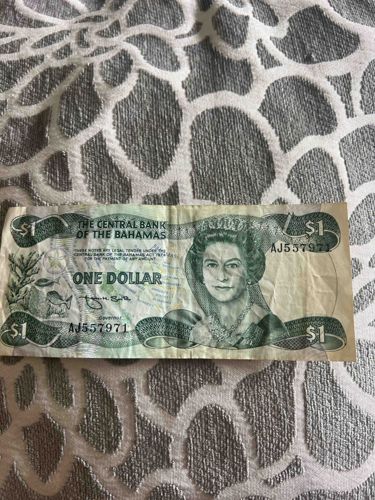
This item is a one-dollar banknote from The Central Bank of The Bahamas. The note features a portrait of Queen Elizabeth II on the right side, depicted wearing a crown and a necklace. The dominant color scheme of the note is green and cream/beige, giving it a somewhat faded appearance. On the left side, there is an image of what appears to be a conch shell and possibly other tropical flora, consistent with the imagery often found on Caribbean currency. The denomination is clearly marked as "ONE DOLLAR" in the center, and "$1" symbols are present in all four corners, though the top left is partially obscured. The serial number "AJ557971" is visible in two locations, below the conch on the left and above the queen on the right. "THE CENTRAL BANK OF THE BAHAMAS" is printed at the top center. Below this, there is finer print, likely indicating the legal tender status and issuing authority, though it is difficult to read. The note shows noticeable signs of wear, including multiple creases and folds across its surface, suggesting it has been extensively circulated. There are no obvious tears or major rips, but the overall crispness is lost. The edges appear worn, consistent with a used banknote. The craftsmanship appears to be standard for banknotes of its era, with intricate engravings for security purposes. Based on the presence of Queen Elizabeth II's portrait, it likely dates from the period of her reign, and considering the aged appearance and common design elements for Bahamian currency, it could be from the mid to late 20th century.
AI Appraisal Report
Upon examining the provided images of this Bahamian One Dollar Banknote featuring Queen Elizabeth II, my assessment indicates that it is an authentic circulated banknote. The design elements, including the portrait, denomination, serial numbers (AJ557971), and the imagery of the conch shell and tropical flora, are consistent with known issues of Bahamian currency from The Central Bank of The Bahamas.
However, the note's condition significantly impacts its value. It exhibits considerable wear, including multiple creases and folds, evident circulation, and a loss of original crispness. While there are no obvious tears or major rips, the worn edges and faded appearance place it squarely in 'Good' to 'Very Good' condition, not higher uncirculated or extremely fine grades.
In terms of market conditions, Bahamian dollar banknotes featuring Queen Elizabeth II are relatively common, particularly those from the mid to late 20th century. There is a steady collector demand for world paper money, but this specific denomination and design, in circulated condition, is not considered rare. Comparables in similar condition typically trade for slightly above face value, driven primarily by their novelty or as starter pieces for new collectors. Uncirculated examples would command significantly higher prices.
Factors significantly impacting this note's value include its commonality, the relatively low face value, and primarily its heavily circulated condition.
It is important to state that this appraisal is based solely on the provided image. While visual cues strongly suggest authenticity, definitive authentication would require an in-person physical examination. This would allow for tactile inspection of the paper's texture, verification of security features such as watermarks, embedded security threads, and microprinting, which cannot be reliably assessed from images alone. Spectroscopic analysis or chemical testing for ink composition, and a thorough review of provenance documentation, would further confirm authenticity and provide a more robust appraisal.