These notes were written by the person who submitted this item. Appraiser.AI has not verified them, and the AI's identification and estimate may rely on them.
AI Estimated Value
Not an official valuation
$5 - $15
AI estimate as of November 3, 2025 · verify with a professional before acting
AI-Generated · Verify before acting
Everything on this page is generated by AI for informational purposes only. AI can make mistakes — the AI may misidentify items or misattribute them (artist, maker, brand, designer, origin, era). This is not an official valuation and should not be used for insurance, sale, tax, estate, legal, or lending purposes — or any decision requiring a certified appraisal. It is not an authoritative claim about any person, brand, or rights holder — do not share or rely on it as a factual statement about a third party. Always consult qualified professionals before making financial decisions.
This analysis also relies on unverified notes provided by the user, which may be incomplete or inaccurate and could affect the result.
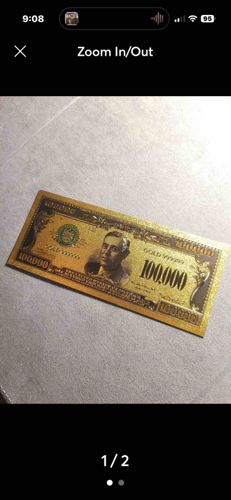
This item is a commemorative banknote, styled after a historical United States currency bill, made with a gold-colored material. The bill is rectangular in shape, consistent with standard currency dimensions, and exhibits a uniform golden hue across its entire surface, suggesting it is either gold-plated or made from a gold-toned metallic foil or polymer. It features intricate detailing reminiscent of genuine banknotes, including a finely engraved portrait of a figure, possibly Woodrow Wilson (who appeared on the original $100,000 gold certificate). The denomination '100,000' is prominently displayed in the bottom left and top right corners, as well as centrally with the text 'ONE HUNDRED THOUSAND DOLLARS' below the portrait. Above the central denomination, the words 'GOLD WEIB' are visible, which appears to be a typo for 'GOLD SPECIE' or 'GOLD CERTIFICATE', indicating its commemorative nature and lack of legal tender status. A circular seal with an eagle motif is present on the left side. The texture appears smooth with a slight reflectivity, characteristic of metallic finishes. There are no visible condition issues such as tears, creases, or significant wear, suggesting it is in excellent, possibly new, condition. Given its appearance and the '24ct gold bill' context, it is likely a decorative or collectible item rather than actual currency. The craftsmanship appears to be of decent quality for an item of this type, with clear printing and detailed engravings, though it is not a genuine government-issued banknote. Its estimated age is contemporary, likely produced within the last few decades, as such commemorative pieces are commonly made.
AI Appraisal Report
I have thoroughly examined the provided image of the Commemorative US-style 100,000 Dollar Gold Banknote. My assessment is that this is a novelty or decorative item, not an authentic piece of currency. The phrasing "GOLD WEIB" instead of "GOLD CERTIFICATE" confirms its commemorative nature. The item appears to be in excellent, uncirculated condition, with no visible signs of wear, tears, or creases, and the craftsmanship for a novelty item seems good, with clear printing and detailed engravings. However, despite the owner's description of it being a "24ct gold bill," based on visual inspection, it is almost certainly not solid 24-carat gold. Such an item, if solid gold, would weigh hundreds of grams and be valued at tens of thousands of dollars for its gold content alone, which is inconsistent with typical novelty items. It is far more likely to be a gold-plated metallic foil or polymer, or simply gold-toned.
Market conditions for such commemorative or novelty items are generally low. They are easily mass-produced and widely available online from various vendors. Comparables typically sell in the range of a few dollars to perhaps fifteen dollars. Demand for these items is limited to collectors of novelty currency or those seeking decorative pieces. Rarity is extremely low, as they are contemporary productions. The primary factor impacting value is its status as a non-currency item and the probable lack of significant precious metal content. To definitively confirm the material composition and gold content, a physical examination would be absolutely necessary, including X-ray fluorescence (XRF) testing, specific gravity tests, or other metallurgical analysis. Without this, I must value it as a decorative souvenir.