AI estimate as of July 25, 2025 · verify with a professional before acting
AI-Generated · Verify before acting
Everything on this page is generated by AI for informational purposes only. AI can make mistakes — the AI may misidentify items or misattribute them (artist, maker, brand, designer, origin, era). This is not an official valuation and should not be used for insurance, sale, tax, estate, legal, or lending purposes — or any decision requiring a certified appraisal. It is not an authoritative claim about any person, brand, or rights holder — do not share or rely on it as a factual statement about a third party. Always consult qualified professionals before making financial decisions.
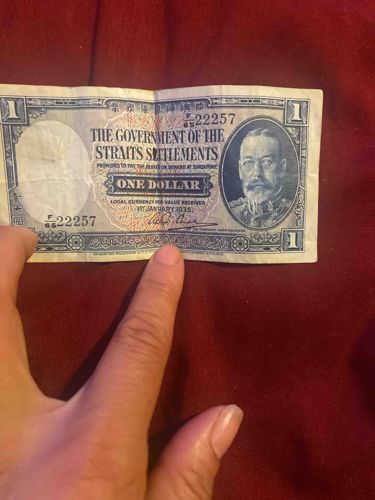
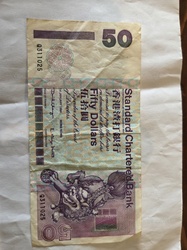
This is a one dollar banknote issued by The Government of the Straits Settlements, dated January 1, 1935. The note features a portrait of King George V on the right side, a common element for British colonial currencies of this era. The central text officially states 'THE GOVERNMENT OF THE STRAITS SETTLEMENTS PROMISES TO PAY THE BEARER ON DEMAND AT SINGAPORE ONE DOLLAR LOCAL CURRENCY FOR VALUE RECEIVED'. The serial number 'E/65 22257' is prominently displayed in the upper right and lower left corners. The overall color scheme appears to be shades of blue and gray with a white background, typical for banknotes of this period.
Physical characteristics show a rectangular paper note. It exhibits visible signs of circulation and wear, including several folds, most notably a prominent vertical crease through the center and horizontal creases, indicating it has been handled. Despite the folds, the paper appears to be relatively intact with no apparent tears or major losses, though the exact condition of the edges and corners isn't fully clear. A distinct watermark area is visible on the left side, though the specific watermark image is not discernible from this angle. The printing quality appears to be high, with fine details still visible in the portrait and intricate border designs. The item shows a natural patina consistent with its age and use. The specific style period is early 20th century, reflecting the British colonial administration's design choices for its currency. The note's condition would be graded as 'Fine' or 'Very Fine' given the visible folds but apparent lack of significant damage like rips or holes.
AI Appraisal Report
I have carefully examined the provided image of this One Dollar Straits Settlements Banknote (1935 King George V). Based on my visual assessment, the note appears to be authentic, exhibiting design elements, printing quality, and wear patterns consistent with genuine currency from this period. The 'E/65 22257' serial number is clearly visible, and the portrait of King George V, central text, and intricate border designs align with known examples of this issue.
Regarding condition, the note shows clear signs of circulation and handling. The prominent vertical and horizontal creases indicate significant folding. While the description states no apparent tears or major losses, these folds, especially the central one, are quite deep. The edges and corners would require physical inspection to confirm their integrity. Given these visible signs of wear, I would grade this note in the Fine (F) to Very Fine (VF) range. For a more precise grading, a 'Very Fine 20' or 'Very Fine 25' might be appropriate after physical handling allows for detailed examination of corner sharpness, overall crispness, and absence of pinholes or minor tears.
Market conditions for Straits Settlements banknotes, especially those depicting King George V, are generally stable, with consistent collector demand. Specific issue dates and denominations can influence value. This 1935 one-dollar note is a common date for the series, but its historical significance as colonial currency from a significant British outpost maintains its appeal. Rarity is moderate; while not exceptionally rare, clean high-grade examples are increasingly difficult to source. The primary factors impacting its value are its condition (the folds do detract) and the universal appeal of British colonial issues.
It is crucial to note the limitations of remote appraisal. While the visual indicators suggest authenticity, a definitive verification requires in-person examination. I would need to physically inspect the paper for watermarks (to verify the specific type and placement), check for fiber content, examine the security threads (if present in this issue), and conduct UV light testing for any repairs, alterations, or counterfeiting indicators. Provenance documentation, such as records of previous ownership or acquisition, would further solidify its authenticity and history, though it's less critical for common issues like this one. Without physical examination, I cannot definitively rule out the possibility of a high-quality reproduction or clever repair.