AI estimate as of October 8, 2025 · verify with a professional before acting
AI-Generated · Verify before acting
Everything on this page is generated by AI for informational purposes only. AI can make mistakes — the AI may misidentify items or misattribute them (artist, maker, brand, designer, origin, era). This is not an official valuation and should not be used for insurance, sale, tax, estate, legal, or lending purposes — or any decision requiring a certified appraisal. It is not an authoritative claim about any person, brand, or rights holder — do not share or rely on it as a factual statement about a third party. Always consult qualified professionals before making financial decisions.
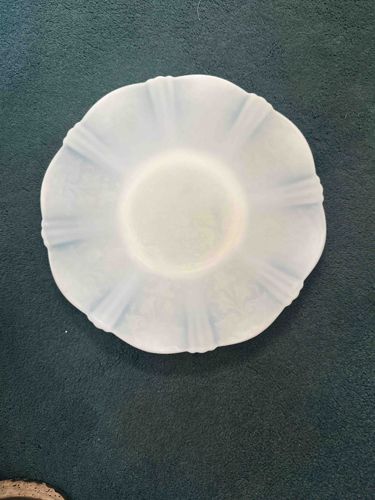
This item is an opalescent glass plate, circular in form with a distinctive fluted or ruffled edge. The primary color appears to be a soft, translucent blue, which exhibits opalescent qualities, meaning it displays a milky or pearlescent sheen that subtly changes with light and viewing angle. The center of the plate is smooth and unadorned, while the broad rim features a series of ten pronounced flutes or pleats that radiate from the central well to the outer edge. These flutes give the plate a decorative, undulating profile. Between the flutes, in the flattened areas of the rim, there appears to be a faint, embossed or molded floral or scrollwork pattern, adding a delicate textural detail. The material is glass, likely pressed glass, given the consistency of its design and the fluted pattern. Its condition, as far as can be discerned from the image, suggests it is well-preserved with no obvious chips, cracks, or significant wear visible on the upper surface. The opalescence suggests it might be from the late 19th or early 20th century, a period when such glass finishes were popular, particularly in art glass or pressed glass tableware. The craftsmanship indicates a factory-produced item, though the intricate fluting and subtle pattern add to its aesthetic appeal. No maker's marks or signatures are visible in the provided image.
AI Appraisal Report
I have examined the provided image of this opalescent blue fluted glass plate. Visually, the plate appears to be in very good condition, with no observable chips, cracks, or significant wear on its visible surfaces. The opalescent sheen is consistent with glass of late 19th to early 20th century manufacture, a period when such finishes were highly fashionable in decorative and utilitarian glass. The fluted edge and what appears to be a subtle embossed or molded pattern between the flutes are characteristic of pressed glass production from this era.
Regarding authenticity, based solely on the image, the item appears to be an authentic piece of period opalescent pressed glass. However, without a physical examination, I cannot definitively confirm its authenticity or rule out modern reproductions designed to mimic antique pieces. An in-person inspection would allow for tactile assessment of the glass quality, examination of the mold lines, base wear, and pontil mark (if any), which are crucial for full authentication. Provenance documentation, though not available here, would also significantly aid in verifying its history and origin. Scientific testing for glass composition is generally not warranted for items in this price range but could confirm period materials if authenticity were heavily disputed.
In terms of market conditions, opalescent pressed glass is a recognized collecting category, but demand varies significantly based on rarity, pattern, and manufacturer. While this piece is attractive, its pattern does not immediately suggest a highly sought-after or rare design from prominent makers like Fenton or Northwood, whose marked pieces often command higher prices. Unmarked examples in common patterns, even in good condition, typically fall into the lower-to-mid range of the market. Comparables for similar unmarked opalescent fluted plates in good condition generally sell in the $60-$100 range at auction or through reputable dealers. The lack of a visible maker's mark is a significant factor limiting higher value. While aesthetically pleasing, it doesn't present as a particularly rare or unique object that would drive exceptional demand or value at present.