AI estimate as of July 19, 2025 · verify with a professional before acting
AI-Generated · Verify before acting
Everything on this page is generated by AI for informational purposes only. AI can make mistakes — the AI may misidentify items or misattribute them (artist, maker, brand, designer, origin, era). This is not an official valuation and should not be used for insurance, sale, tax, estate, legal, or lending purposes — or any decision requiring a certified appraisal. It is not an authoritative claim about any person, brand, or rights holder — do not share or rely on it as a factual statement about a third party. Always consult qualified professionals before making financial decisions.
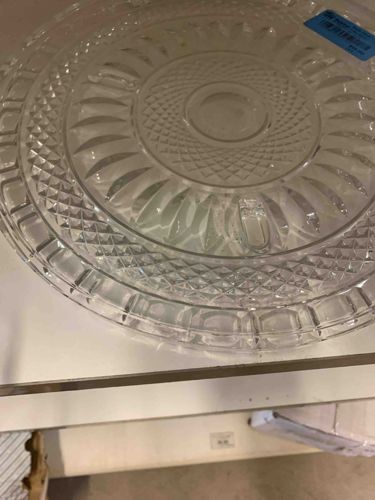
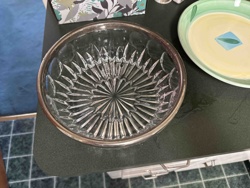
This item is a clear glass serving platter, circular in shape, designed for presenting food. Its physical characteristics indicate it is made from molded glass, likely pressed glass, given the crispness of its patterns and uniformity. The platter features an intricate decorative design that radiates from the center. The central circular area has a fine diamond-hatch pattern, which is encircled by a band of tear-drop or lotus petal-shaped facets. Beyond this, a wider outer band displays a more pronounced diamond pattern, reminiscent of traditional cut glass, though likely molded. The rim appears to be substantial, possibly with a subtle scalloped edge that picks up on the inner faceting. There are no immediate signs of significant damage such as chips, cracks, or deep scratches visible in the provided image, suggesting it is in good, used condition. A blue price tag is adhered to one section of the rim, indicating it is likely from a retail environment, possibly a thrift store or reseller. The manufacturing details are not discernible from the image; there are no visible maker's marks, signatures, or stamps. Based on its design characteristics, which include a blend of classic cut-glass inspired patterns, it likely dates from the mid to late 20th century, possibly 1970s-1990s, when pressed glass items simulating cut glass were popular for everyday use and entertaining. The craftsmanship appears to be of standard quality for mass-produced pressed glass, with good clarity and defined patterns, suggesting a competent manufacturing process. The overall design aims for an elegant presentation, suitable for appetizers, desserts, or other food items.
AI Appraisal Report
Upon visual examination of the images provided, I have assessed this clear glass serving platter. The piece is circular, featuring intricate molded patterns, including a central diamond-hatch design, a band of lotus-petal-like facets, and an outer rim with a larger diamond pattern. This is characteristic of pressed glass manufactured in the mid-to-late 20th century (circa 1970s-1990s), designed to emulate the more expensive cut glass. The platter appears to be in good, well-preserved condition, with no visible chips or cracks. The clarity of the glass and the definition of the patterns suggest a standard, mass-produced quality item.
The current market for such pressed glass serveware is generally saturated. These items were produced in large quantities by numerous manufacturers. Comparable platters from makers like Indiana Glass or Anchor Hocking with similar 'Daisy and Button' or 'Hobstar' patterns typically sell in the secondary market, such as online marketplaces and thrift stores. Rarity and demand for this specific, unmarked pattern are low. The primary factor influencing its value is its decorative and functional utility rather than collectibility or brand recognition.
A significant limitation of this appraisal is its reliance on images alone. A physical inspection is necessary to confirm the absence of subtle flaws like hairline cracks or scuffs, identify any potential maker's marks not visible in the photos, and assess the glass quality firsthand. Without a manufacturer's mark or specific pattern name, attributing it to a sought-after maker is impossible, which significantly limits its potential value.