These notes were written by the person who submitted this item. Appraiser.AI has not verified them, and the AI's identification and estimate may rely on them.
AI Estimated Value
Not an official valuation
$50 - $150
AI estimate as of September 26, 2025 · verify with a professional before acting
AI-Generated · Verify before acting
Everything on this page is generated by AI for informational purposes only. AI can make mistakes — the AI may misidentify items or misattribute them (artist, maker, brand, designer, origin, era). This is not an official valuation and should not be used for insurance, sale, tax, estate, legal, or lending purposes — or any decision requiring a certified appraisal. It is not an authoritative claim about any person, brand, or rights holder — do not share or rely on it as a factual statement about a third party. Always consult qualified professionals before making financial decisions.
This analysis also relies on unverified notes provided by the user, which may be incomplete or inaccurate and could affect the result.
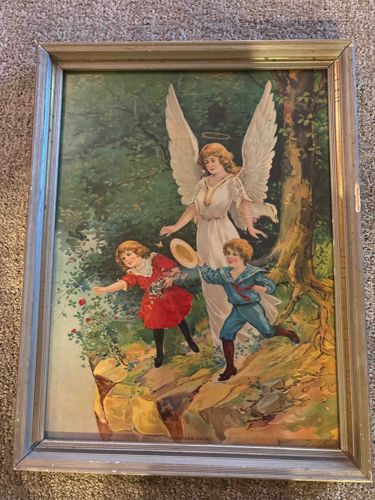
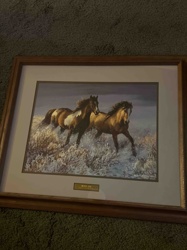
This item is a framed print depicting a classic scene of a guardian angel watching over two children. The print itself appears to be a chromolithograph or a similar reproduction technique, characterized by its vibrant colors and detailed imagery, often seen in late 19th to early 20th-century religious or sentimental art. The central figure is a serene-looking angel with large, white, feathered wings and a golden halo, dressed in a flowing white gown with golden accents. She is positioned slightly behind and between two children. To the left, a girl in a red dress with ruffled collar and black hose/shoes reaches out towards a bush laden with pink roses, holding a small bouquet. To the right, a boy in a blue sailor-style outfit with a red cravat and reddish-brown boots runs along, holding what appears to be a light-colored hat. Both children have reddish-brown hair. They are traversing a rocky, verdant landscape with lush green foliage and trees in the background. The overall color palette is rich and somewhat muted, typical of period prints, with greens, blues, reds, and warm earthy tones dominating. The print is housed in a simple wooden frame, possibly gilded or painted in a 'shabby chic' style with a light, grayish-silver finish that shows signs of wear and chipping, particularly along the edges and corners. There are visible scuffs and minor losses of finish on the frame, consistent with age and handling. The print itself exhibits some signs of age, such as potential fading, minor discoloration, and possibly some surface dirt under the glass (if present), but no major tears or egregious damage are immediately visible from the provided image. The artistic style is sentimental and idealistic, reflecting popular themes of innocence and divine protection. This type of print was highly popular for home decor during the Victorian and Edwardian eras, suggesting an estimated age from the late 19th century to the early 20th century. The craftsmanship, though a reproduction, would have aimed for high-quality color rendering for its time.
AI Appraisal Report
I have examined the image of this 'The Guiding Angel' print. My assessment is that this is a late 19th to early 20th-century chromolithograph or similar reproduction, consistent with popular religious and sentimental art of the Victorian and Edwardian eras. The print shows good color retention for its age, with typical muted tones. The frame, a light grayish-silver ‘shabby chic’ style, exhibits scuffs and chipping, indicative of age and handling, but seems to generally complement the print's aesthetic without being a high-value piece itself. The overall condition appears fair to good for a period domestic item, with no obvious major tears or water damage visible, though minor discoloration or fading inherent to prints of this age is likely.
Authenticity of the print as a period mass-produced item appears consistent with visual cues. However, without in-person examination, I cannot definitively confirm the print medium nor rule out later reproductions. Physical inspection would allow for examination of paper type, printing technique, and direct assessment of color vibrancy and any underlying foxing or moisture damage beneath the glass. Provenance documentation, if available, could further confirm its age and history.
The market for such antique religious or sentimental prints is stable but generally not high-value. While there is consistent demand from collectors of Americana, religious artifacts, or those seeking period decor, these pieces are not rare. Factors impacting value include the sentimental subject matter (which appeals to a niche market), and the condition of both print and frame. Due to its reproduction nature and commonality, significant rarity is not a factor. Given these considerations, and based solely on the provided image, I appraise this framed print at a value of $50 - $150.