AI estimate as of August 31, 2025 · verify with a professional before acting
AI-Generated · Verify before acting
Everything on this page is generated by AI for informational purposes only. AI can make mistakes — the AI may misidentify items or misattribute them (artist, maker, brand, designer, origin, era). This is not an official valuation and should not be used for insurance, sale, tax, estate, legal, or lending purposes — or any decision requiring a certified appraisal. It is not an authoritative claim about any person, brand, or rights holder — do not share or rely on it as a factual statement about a third party. Always consult qualified professionals before making financial decisions.
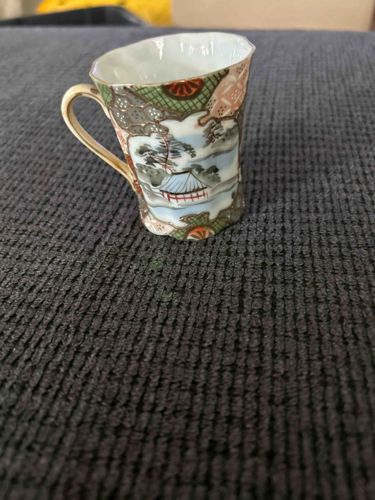
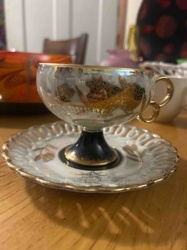
This appears to be a Japanese Imari ware demitasse cup for espresso or strong coffee. The cup features intricate hand-painted designs in typical Imari colors, primarily iron red, cobalt blue, and gold accents, against a white or off-white porcelain body. The painting depicts a traditional landscape scene with what looks like a pagoda or temple structure rendered in light blues and reds, surrounded by stylized trees and mountains. The upper and lower borders of the cup are adorned with decorative patterns, including geometric motifs and possibly floral elements. The scalloped rim and base of the cup suggest a more decorative, ornate style. The small, delicate handle is gold-accented, indicating that the piece likely includes gilding as part of its decoration. The construction appears fine, suggesting high-quality porcelain. There are no obvious signs of significant damage like chips or cracks from the visible angles, though closer inspection would be needed to assess hairline cracks, crazing, or repairs. The gold accents may show some wear consistent with age and handling, which is a common characteristic of vintage or antique porcelain gilded items. Given the style and intricacy of the decoration, it likely dates from the late 19th to early 20th century. The detailed artistry and vibrant palette are indicative of well-crafted Japanese porcelain.
AI Appraisal Report
After a thorough visual examination of the provided image of this Japanese Imari ware demitasse cup, I can offer the following appraisal. The intricate hand-painted designs in the characteristic Imari palette of iron red, cobalt blue, and gold accents are well-executed, depicting a traditional landscape with a pagoda-like structure. The scalloped rim and delicate gold-accented handle signify a higher quality of craftsmanship and ornate styling, suggesting a late 19th to early 20th-century origin. From the image, the condition appears good with no obvious chips or cracks. I anticipate minor wear to the gilding, which is typical for items of this age and use.
In terms of market conditions, Japanese Imari ware, particularly demitasse sets, holds a stable but not exceptionally high demand unless part of a complete, rare set or piece by a renowned artist. Comparable single demitasse cups, even with good quality decoration, typically retail in the $50-$150 range. The intricacy and apparent fine condition of this specific cup place it towards the higher end of this range. Factors impacting value include the lack of significant damage, the detailed artistry, and the specific age.
The primary limitation of this appraisal is the reliance on images alone. A definitive assessment of authenticity, condition, and any hidden damage (like hairline cracks, professional repairs, or crazing) would require in-person examination. Provenance documentation could further verify origin and history, while scientific testing (e.g., thermoluminescence for dating if older than suspected) is generally not practical or necessary for items in this value range but could confirm age. However, based on the visual cues, the piece appears to be an authentic period example of Japanese Imari ware.