AI estimate as of December 1, 2025 · verify with a professional before acting
AI-Generated · Verify before acting
Everything on this page is generated by AI for informational purposes only. AI can make mistakes — the AI may misidentify items or misattribute them (artist, maker, brand, designer, origin, era). This is not an official valuation and should not be used for insurance, sale, tax, estate, legal, or lending purposes — or any decision requiring a certified appraisal. It is not an authoritative claim about any person, brand, or rights holder — do not share or rely on it as a factual statement about a third party. Always consult qualified professionals before making financial decisions.
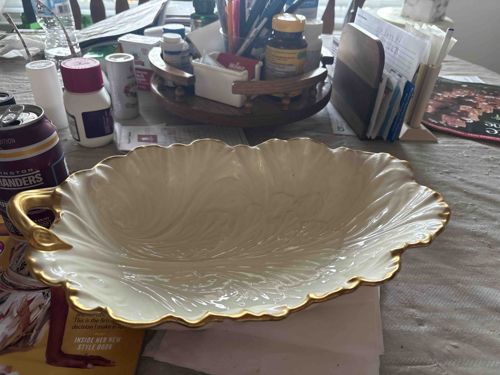
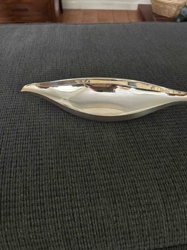
This item is an elegant, horizontally oriented dish, likely made of porcelain or ceramic, featuring a prominent lustreware glaze that gives it an iridescent, shimmering quality, particularly noticeable in the white body. The dish is characterized by its distinctive scalloped, wavy rim, which adds a decorative and fluid aesthetic. From the provided images, it appears to be approximately 10-14 inches in length based on its apparent size relative to surrounding objects. The primary color of the dish's body is an off-white or cream, exhibiting a subtle pearlescent sheen. A striking detail is the application of rich gold gilding along the entire scalloped edge and on the single, ornate handle visible on the left side. This handle is gracefully curved and solid, contributing to the dish's overall luxurious appearance. The interior surface of the dish features a raised, textured pattern resembling stylized leaves or feathers, adding depth and visual interest to the otherwise smooth glaze. The craftsmanship suggests a moderately high level of quality, with the gilding appearing uniform and the scalloping well-defined. No major visible damage, chips, or significant wear to the gilding is apparent from the images, suggesting good to excellent condition. The design hints at a mid-20th century to contemporary style, possibly intended for serving or purely decorative purposes. Without a visible maker's mark, the exact origin or manufacturer is not determinable, though its style is reminiscent of fine porcelain wares from companies known for decorative tableware.
AI Appraisal Report
Upon examining the provided images of this Lustreware Scalloped Dish with Gilt Handle, I've concluded that it is in good to excellent condition, with no apparent chips, cracks, or significant wear to the gilding. The lustreware glaze appears well-preserved, showcasing its intended iridescence.
Authenticity, based solely on visual examination of images, is challenging to confirm definitively. While the craftsmanship suggests a moderately high level of quality, I cannot verify the material (porcelain vs. ceramic) or the origin without a physical inspection. A physical examination would allow me to assess the weight, texture, and finer details of the glaze and gilding, as well as search for any hidden maker's marks.
In terms of market conditions, decorative lustreware dishes, especially those without a distinguished maker's mark or historical provenance, typically fall within an accessible price range. Comparables in the current market, often found in estate sales or online marketplaces, show similar pieces ranging from $30-$80. The scalloped rim and gilt handle add a touch of elegance that slightly enhances its aesthetic appeal and thus its marketability.
Demand for such items is generally moderate. While not a rarity, the good condition and decorative features make it more desirable than plain counterparts. Factors impacting value significantly include the lack of a discernible maker's mark, which prevents attribution to a specific, potentially high-value manufacturer. If a prominent maker's mark were present (e.g., from a renowned porcelain manufacturer), the value could increase substantially. Furthermore, assessing the true quality of the gilding and its resilience to wear would require in-person scrutiny. Without provenance documentation or scientific testing, its exact age and origin remain estimations based on stylistic cues (mid-20th century to contemporary). Given these considerations, my appraised value reflects its decorative appeal and good condition, while acknowledging the limitations of image-based assessment.