These notes were written by the person who submitted this item. Appraiser.AI has not verified them, and the AI's identification and estimate may rely on them.
AI Estimated Value
Not an official valuation
$20-40
AI estimate as of December 13, 2025 · verify with a professional before acting
AI-Generated · Verify before acting
Everything on this page is generated by AI for informational purposes only. AI can make mistakes — the AI may misidentify items or misattribute them (artist, maker, brand, designer, origin, era). This is not an official valuation and should not be used for insurance, sale, tax, estate, legal, or lending purposes — or any decision requiring a certified appraisal. It is not an authoritative claim about any person, brand, or rights holder — do not share or rely on it as a factual statement about a third party. Always consult qualified professionals before making financial decisions.
This analysis also relies on unverified notes provided by the user, which may be incomplete or inaccurate and could affect the result.
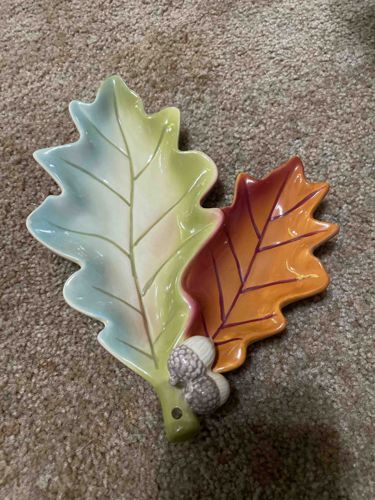
This is a decorative ceramic dish designed in the shape of two overlapping oak leaves, adorned with a pair of acorns. The dish exhibits a vibrant, multicolored glaze, primarily featuring shades of green, blue, brown, and orange, mimicking autumnal foliage. The larger leaf, positioned largely on the left, transitions from a pale blue at its tip to a light green and then a faint pinkish hue towards its base. The smaller, right-hand leaf is predominantly orange with reddish-brown edges, suggesting a more advanced stage of autumn. Both leaves feature prominent, raised vein detailing that is accentuated by the glaze, giving them a three-dimensional and realistic texture. At the base of the leaves, where they appear to stem, two intricately crafted ceramic acorns are attached. These acorns have textured, light grey caps and smoother, off-white bodies, adding further detail and visual interest. The construction appears to be molded ceramic with a glossy, probably lead-free, finish. A small, circular hole is visible near the base of the larger leaf, suggesting it might be designed for hanging, indicating its potential use as both a decorative piece and possibly a functional trinket dish. The underside is not visible, so manufacturer's marks or signatures cannot be discerned. The item appears to be in good condition, with no obvious chips, cracks, or significant wear visible from the provided image. The style is distinctly autumnal and decorative, likely produced in the late 20th or early 21st century for seasonal home decor. The craftsmanship is decent, with good attention to detail in the leaf veins and acorn textures, suggesting mass-produced decorative ceramic ware.
AI Appraisal Report
Having carefully examined the provided image and details of this Ceramic Oak Leaf and Acorn Dish, I can offer the following appraisal. The dish appears to be in good condition, showing no visible chips, cracks, or significant wear. The vibrant, multi-colored glaze, mimicking autumnal foliage, is well-executed, with good attention to detail in the raised vein work of the leaves and the texture of the acorns. This suggests a mass-produced decorative ceramic item, likely from the late 20th or early 21st century, consistent with the 'ROSS' details provided.
authenticity, based solely on visual examination, is difficult to confirm definitively. This type of decorative ceramic is not typically forged, but without a physical inspection, I cannot verify the material composition or rule out any hidden damage or repairs. Provenance documentation or manufacturer's marks (which are not visible from the underside) would be helpful for more precise dating and origin.
Market conditions for such decorative autumnal ceramic pieces are generally moderate. While appealing for seasonal decor, these items are quite common. Comparables typically sell in the range of $15-50, depending on size, condition, and specific maker if known. Demand is steady but not exceptional, and rarity is low as similar items were widely produced. The 'hanging hole' suggests dual functionality, which adds a slight versatility. Factors impacting value here include its good condition and attractive autumnal theme. However, its mass-produced nature and the absence of a discernible maker or unique features prevent it from achieving a higher valuation. A physical inspection would allow for examination of the underside for marks, assessment of weight and glaze quality firsthand, and confirmation of condition.