AI estimate as of August 27, 2025 · verify with a professional before acting
AI-Generated · Verify before acting
Everything on this page is generated by AI for informational purposes only. AI can make mistakes — the AI may misidentify items or misattribute them (artist, maker, brand, designer, origin, era). This is not an official valuation and should not be used for insurance, sale, tax, estate, legal, or lending purposes — or any decision requiring a certified appraisal. It is not an authoritative claim about any person, brand, or rights holder — do not share or rely on it as a factual statement about a third party. Always consult qualified professionals before making financial decisions.
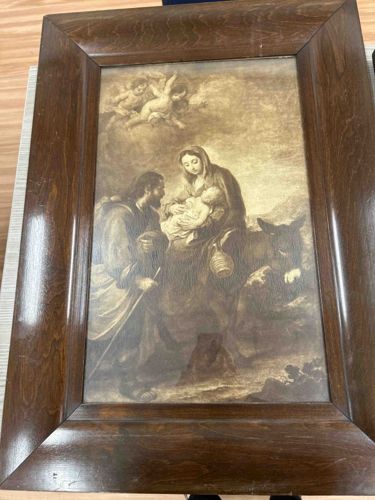
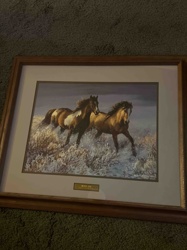
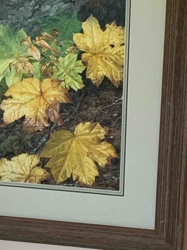
This item is a framed sepia-toned art print depicting a religious scene, likely 'The Flight into Egypt' or a similar narrative involving the Holy Family. The print is housed within a sturdy, possibly oak or stained hardwood frame with a dark brown, almost reddish-brown finish. The frame exhibits a traditional, somewhat rounded profile with carved or molded details along the inner and outer edges, giving it a classic appearance. The wood grain is visible through the finish, suggesting solid wood construction rather than veneer. Physical characteristics include an observable perimeter, indicating it is rectangular in shape, designed for vertical display. The image itself features Mary holding the infant Jesus, with Joseph beside them, and what appears to be a burro or donkey to their right. Above them, in the sky, are several cherubic figures or putti, typical of Renaissance and Baroque art. The print has a soft, muted aesthetic due to its sepia tones, creating a sense of age and depth. Visible condition issues on the frame include several scratches, scuffs, and abrasions, particularly noticeable on the broader, flatter surfaces and edges, indicating general wear consistent with its age and handling. Some areas of the finish appear lighter, perhaps due to rubbing or minor loss of varnish. The print itself appears to be in relatively good condition, though it is difficult to assess fine details due to reflection off the protective glazing (presumably glass or acrylic). There are no discernible maker's marks, signatures, or stamps visible on the print or frame from the provided images. Based on the subject matter and sepia tone, the print likely dates from the late 19th to early 20th century, a period when such religious reproductions were popular. The craftsmanship of the frame is robust, suggesting good, practical quality, though not overtly ornate or of museum-grade finesse. The overall piece has a devotional and somewhat nostalgic appeal.
AI Appraisal Report
Based on my visual examination of the provided images, this framed sepia print depicts a devotional scene of the Holy Family, likely 'The Flight into Egypt.' The print's sepia tone and subject matter suggest a likely production period from the late 19th to early 20th century. The frame appears to be solid wood, possibly oak, with a dark, reddish-brown finish, exhibiting traditional molded details.
Condition: The frame shows significant wear consistent with age, including numerous scratches, scuffs, and abrasions, and some loss of finish. The print itself appears in relatively good condition through the glazing, though fine detail assessment is limited.
Authenticity: Without physical inspection, I cannot verify the print's original production method (e.g., photogravure, collotype) or confirm if it is indeed a period piece. There are no visible maker's marks. For full authentication, an in-person examination would be required to assess paper type, print process, and potential hidden signatures or stamps. Provenance documentation would also significantly aid in authenticity and value verification.
Market Conditions & Demand: Religious prints from this era are relatively common on the secondary market. While there is steady demand for devotional art, a print of this type, lacking a known artist or significant historical provenance, typically appeals to a niche collector base or individuals seeking decorative religious items. Rarity is low; similar items are frequently encountered.
Factors Impacting Value: The primary value drivers are its decorative appeal and devotional subject matter. The frame's condition, while adding to its antique character, also limits its higher-end market potential. The lack of verifiable artist, unique print process, or historical significance keeps its value modest. Limited demand from fine art collectors.
Limitations: My valuation is based solely on visual assessment from images. A hands-on inspection, out-of-frame examination, and potential scientific testing (e.g., dating techniques for paper, analysis of print medium) would be necessary for a definitive authentication and more precise valuation.