Late Victorian Pressed Wood Gingerbread Mantel Clock
Antique Horology / Furniture

Late Victorian Pressed Wood Gingerbread Mantel Clock

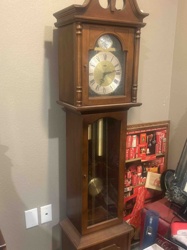
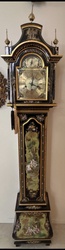
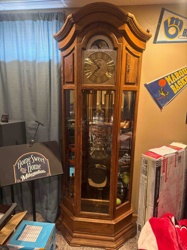
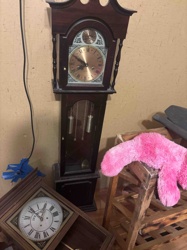
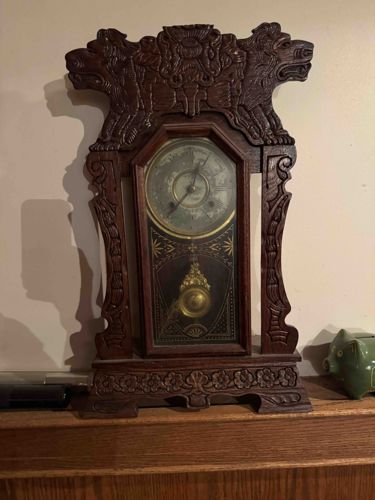
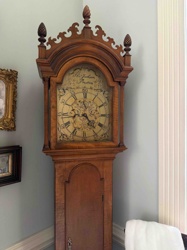
This is an antique mantel clock, often referred to as a 'gingerbread' or kitchen clock, likely dating from the late 19th to early 20th century (circa 1880-1910). The case is constructed from oak with elaborate decorative elements created through a steam-pressed wood process rather than hand-carving, a common manufacturing technique of the Victorian era. The most striking feature is the top crest, which depicts two highly stylized, outward-facing animal heads—possibly lions or griffins—separated by a central floral or shell motif. This zoomorphic imagery is supported by side columns with C-scroll and wave-like textures. The base carries a consistent floral relief pattern. The clock face is housed behind a tombstone-shaped glass door that features a faint gold-stenciled or etched pattern on the lower portion, revealing a brass pendulum bob with an embossed decorative design. The dial itself shows significant oxidation and age-related wear to the paper or tin surface, with black Roman numerals and two keyholes for winding the time and strike mechanisms. Condition shows an aged patina throughout the wood, with possible light scuffing on the base edges and significant fading of the dial's original details. These clocks were mass-produced by companies like E. Ingraham, Ansonia, or Seth Thomas, though no specific maker's mark is visible without inspecting the rear movement.
Estimated Value

$150 - $250

Basic Information

Category

Antique Horology / Furniture

Appraised On

March 3, 2026

Estimated Value

$150 - $250

Item Description

This is an antique mantel clock, often referred to as a 'gingerbread' or kitchen clock, likely dating from the late 19th to early 20th century (circa 1880-1910). The case is constructed from oak with elaborate decorative elements created through a steam-pressed wood process rather than hand-carving, a common manufacturing technique of the Victorian era. The most striking feature is the top crest, which depicts two highly stylized, outward-facing animal heads—possibly lions or griffins—separated by a central floral or shell motif. This zoomorphic imagery is supported by side columns with C-scroll and wave-like textures. The base carries a consistent floral relief pattern. The clock face is housed behind a tombstone-shaped glass door that features a faint gold-stenciled or etched pattern on the lower portion, revealing a brass pendulum bob with an embossed decorative design. The dial itself shows significant oxidation and age-related wear to the paper or tin surface, with black Roman numerals and two keyholes for winding the time and strike mechanisms. Condition shows an aged patina throughout the wood, with possible light scuffing on the base edges and significant fading of the dial's original details. These clocks were mass-produced by companies like E. Ingraham, Ansonia, or Seth Thomas, though no specific maker's mark is visible without inspecting the rear movement.
Get Your Items Appraised

Instant estimates of your treasures with AI-powered instant appraisals

Browse More Appraisals