AI Appraisal Estimate

AI-generated estimates · not official valuations

From the user

What was submitted

Photo and notes provided by the user — not generated by AI

Submitted item photo
Submitted photo · May 18, 2026

User's notes

No additional notes provided.

AI analysis below

AI appraisal

AI analysis & estimate

AI-Generated · Verify before acting

Everything below is generated by AI for informational purposes only. AI can make mistakes — the AI may misidentify items or misattribute them (artist, maker, brand, designer, origin, era). This is not an official valuation and should not be used for insurance, sale, tax, estate, legal, or lending purposes — or any decision requiring a certified appraisal. It is not an authoritative claim about any person, brand, or rights holder — do not share or rely on it as a factual statement about a third party. Always consult qualified professionals before making financial decisions.

Read the full disclaimer

AI Identification

·Not independently authenticated·Verify before acting

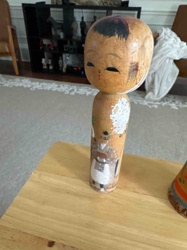
Japanese Creative Kokeshi Doll

Asian Antiques & Collectibles - Japanese Folk Art

AI Estimated Value

·Not an official valuation·Verify before acting

$40-60

As of May 18, 2026

AI Item Analysis

·AI can make mistakes·Verify before acting
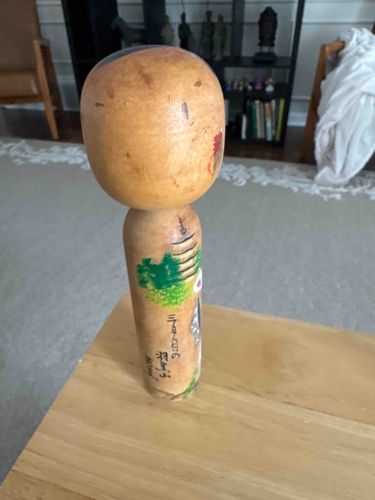
This is a vintage 'Sosaku' or creative style Japanese Kokeshi doll, a traditional folk craft. The object features a large, spherical ovoid head joined to a slender, cylindrical body, carved entirely from a light-toned wood, likely Mizuki (giant dogwood) or cherry, known for their fine grain and density. The wood surface shows a natural honey-colored patina indicative of age. The body is decorated with hand-painted polychrome scenes including a multi-tiered pagoda (likely representing a specific temple), green foliage/tree, and several columns of Japanese kanji calligraphy that appear to describe a location or poem. The top of the head shows a dark painted area representing hair. Physically, the doll exhibits significant signs of wear and age, including scattered surface abrasions, small dark impact dings on the head, and some minor fading or bleeding of the pigments on the body. A notable red mark or scuff is visible on the side of the face. The construction consists of a plug-and-socket or simple glue joint between the head and body. Most Creative Kokeshi from this style date back to the mid-20th century, specifically the 1960s or 1970s. The presence of detailed calligraphy and scenic painting rather than traditional floral patterns suggests this was likely produced as a ‘miyage’ (souvenir) item from a specific Japanese prefecture or temple site. The overall craftsmanship shows steady hand-painting and traditional wood-turning techniques typical of the Tohoku region artisans.
AI Appraisal Report

·AI can make mistakes·Verify before acting
This vintage Sosaku (creative) Kokeshi doll, dating likely to the 1960s or 1970s, presents as an authentic piece of mid-century Japanese folk art. The craftsmanship is consistent with the 'miyage' (souvenir) tradition, featuring detailed hand-painted scenes and calligraphy indicative of a specific tourist destination or temple site, rather than pure artistic abstraction. The wood displays a genuine honey-toned patina that confirms its age. However, the condition is a significant limiting factor for valuation. The item exhibits noticeable surface wear, including impact dings on the head, scattered abrasions, and a distinct red scuff on the face, which detracts from its aesthetic appeal. While there is a steady collector's market for creative Kokeshi, particularly those signed by famous masters like Sansaku Sekiguchi or pieces in pristine condition, this example appears to be a more standard, unsigned (or unverified) souvenir piece with moderate damage. Comparable unsigned vintage souvenir Kokeshi in similar 'good' but not 'mint' condition typically sell in the lower range of the folk art market. To provide a higher valuation or definitive attribution, I would need to physically examine the base for an artist's signature or maker's mark, which is often crucial in Kokeshi valuation. Additionally, an in-person inspection would verify the stability of the head-to-body joint and ensure the wood has no internal splitting or pest damage.

Get your items appraised

Instant estimates of your treasures with AI-powered appraisals

Browse More Appraisals