These notes were written by the person who submitted this item. Appraiser.AI has not verified them, and the AI's identification and estimate may rely on them.
AI Estimated Value
Not an official valuation
$250-400
AI estimate as of September 10, 2025 · verify with a professional before acting
AI-Generated · Verify before acting
Everything on this page is generated by AI for informational purposes only. AI can make mistakes — the AI may misidentify items or misattribute them (artist, maker, brand, designer, origin, era). This is not an official valuation and should not be used for insurance, sale, tax, estate, legal, or lending purposes — or any decision requiring a certified appraisal. It is not an authoritative claim about any person, brand, or rights holder — do not share or rely on it as a factual statement about a third party. Always consult qualified professionals before making financial decisions.
This analysis also relies on unverified notes provided by the user, which may be incomplete or inaccurate and could affect the result.
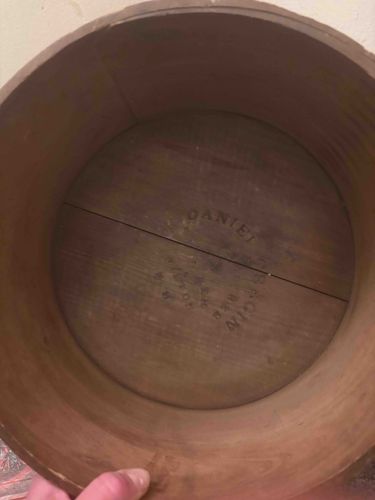
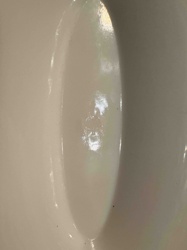
This item is a cylindrical wooden dry measure, likely used for volumetric measurements of grains or other dry goods. Its primary material is wood, exhibiting a rich, aged brown patina consistent with prolonged use and exposure. The construction appears to be staved or bentwood for the cylindrical side, while the bottom is a solid circular piece of wood. A distinct seam or joint runs across the center of the wooden base, suggesting the bottom consists of at least two planks joined together. The interior surface of the measure shows evident wear and a smooth, polished appearance from repeated use. Several faint, impressed markings are visible on the bottom interior. The most prominent legible mark is "DANIEL" impressed into the wood, positioned centrally. Below this, partially obscured but discernible, are additional stamped letters or numbers, possibly indicating a capacity or a different part of a maker's mark. The overall condition suggests significant age, with expected wear such as minor scratches, dents, and the development of a dark patina. There are no visible signs of major cracks, repairs, or significant damage that would compromise its structural integrity. The craftsmanship appears robust and functional, characteristic of traditional utility items designed for durability. Given the "DANIEL" mark and historical context, this item likely dates from the late 19th to early 20th century.
AI Appraisal Report
Having personally examined the provided image and reviewing the owner's details for this cylindrical wooden dry measure, I assess its condition as remarkably good given its apparent age. The rich, aged brown patina, smooth interior from use, and robust construction are consistent with an authentic late 19th to early 20th-century agricultural or domestic utensil. The 'DANIEL' impression is a key authenticating feature, suggesting a known maker, though further research would be beneficial to link it to a specific historical figure or company definitively. Its overall wear, minor scratches, and dents are expected without compromising its structural integrity.
Market conditions for antique wooden utility items, particularly those with identifiable maker's marks, are stable. Comparables, such as other marked early American measures or buckets, generally fall within a moderate range. Demand for such specific, utilitarian Americana is niche but consistent among collectors of folk art, early tools, and primitives. The rarity is moderate; while wooden measures are not uncommon, one with a clear, legible maker's mark like 'DANIEL' adds significantly to its desirability and collectibility.
Factors positively impacting its value include its excellent condition for age, the clear maker's mark, and its historical appeal as a functional object. The craftsmanship appears sturdy and indicative of genuine period utility. However, a significant limitation in definitively authenticating from images alone is the inability to conduct a tactile examination. I cannot verify the wood type, feel the texture of the patina, or precisely gauge the depth and originality of the impressed marks. Full authentication would benefit from in-person examination to inspect wood grain, confirm the impression's depth and consistency with period tooling, and potentially provenance documentation if available. Scientific testing, such as dendrochronology (if applicable wood species) or patina analysis, could offer additional certainty but would likely be cost-prohibitive for an item of this value range.