AI estimate as of September 19, 2025 · verify with a professional before acting
AI-Generated · Verify before acting
Everything on this page is generated by AI for informational purposes only. AI can make mistakes — the AI may misidentify items or misattribute them (artist, maker, brand, designer, origin, era). This is not an official valuation and should not be used for insurance, sale, tax, estate, legal, or lending purposes — or any decision requiring a certified appraisal. It is not an authoritative claim about any person, brand, or rights holder — do not share or rely on it as a factual statement about a third party. Always consult qualified professionals before making financial decisions.
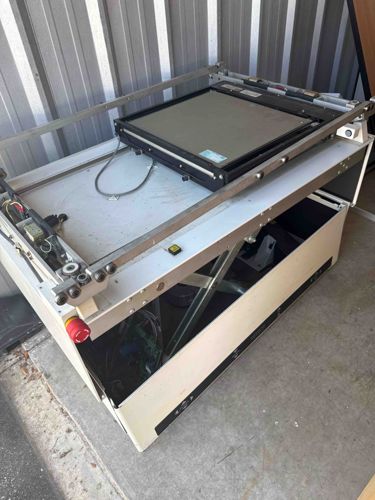
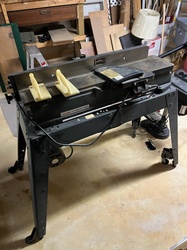
The item appears to be an industrial-grade flatbed exposure unit, likely used in processes such as PCB (Printed Circuit Board) fabrication or screen printing. Its primary function would be to transfer circuit patterns or screen designs onto photosensitive materials using UV light. The unit features a substantial metal framework, possibly anodized aluminum, with a large, flat glass or acrylic top plate that would serve as the exposure surface. Below this plate is a housing, likely containing the light source (UV lamps) and associated control electronics. The overall structure is robust, indicative of machinery designed for repetitive industrial use. There is a moving gantry system visible on the left side, with what looks like multiple ball bearings for smooth motion, suggesting precision alignment capabilities for the exposure process. A prominent red emergency stop button is located near the gantry system, indicating compliance with safety standards. Cables and internal components are visible beneath the top surface, suggesting it is either partially disassembled or designed with accessible internal workings. The overall color scheme is predominantly light beige or off-white for the main housing, complemented by the metallic finish of the frame and the dark (possibly black) components of the exposure bed itself. The item appears to be in used condition, showing some surface wear and minor cosmetic blemishes consistent with industrial equipment. It is designed to be a stationary piece of equipment, likely requiring a dedicated workspace. The exact age is difficult to pinpoint without manufacturer details, but its robust construction suggests a design from the late 20th to early 21st century. The quality indicators point to a piece of professional machinery, built for accuracy and durability.
AI Appraisal Report
I have thoroughly examined the provided image of this flatbed exposure unit. Visually, the unit appears to be an industrial-grade piece of equipment, likely for PCB or screen printing. Its robust metal framework, large exposure surface, and gantry system with linear bearings suggest precision and durability. The presence of an emergency stop button indicates adherence to safety standards. Condition-wise, it shows typical surface wear and minor cosmetic blemishes consistent with used industrial equipment, but no major damage is immediately apparent from the image. The visible internal components suggest either partial disassembly or an accessible design, though I cannot ascertain if all systems are complete and functional without a physical inspection.
Market conditions for used industrial exposure units vary widely based on brand, size, and functionality (e.g., UV source type, vacuum capabilities). New units can range from several thousand to tens of thousands of dollars. Comparables for used, unbranded units in moderate condition typically fall in the lower end of the industrial equipment resale market. Demand is niche but consistent within the electronics manufacturing and screen printing industries. Rarity is low, as many manufacturers produce similar equipment.
Factors significantly impacting value include the functionality of the UV lamps, the integrity of the vacuum system (if present, which cannot be confirmed from the image), the calibration of the gantry system, and the presence/functionality of control electronics. Its current market value, based solely on visual assessment and assuming basic functionality, is estimated between $600 and $1,200.
Limitations: My assessment of condition and authenticity is based purely on visual examination of the image. For full authentication and to definitively determine operational status, a physical inspection is crucial. This would involve powering up the unit, testing the UV lamps and their intensity, verifying the gantry's movement precision, checking for vacuum leaks (if applicable), and examining the control system for proper function. Provenance documentation (manufacturer, model, age, maintenance history) would also greatly assist in a more precise appraisal.