AI estimate as of September 29, 2025 · verify with a professional before acting
AI-Generated · Verify before acting
Everything on this page is generated by AI for informational purposes only. AI can make mistakes — the AI may misidentify items or misattribute them (artist, maker, brand, designer, origin, era). This is not an official valuation and should not be used for insurance, sale, tax, estate, legal, or lending purposes — or any decision requiring a certified appraisal. It is not an authoritative claim about any person, brand, or rights holder — do not share or rely on it as a factual statement about a third party. Always consult qualified professionals before making financial decisions.
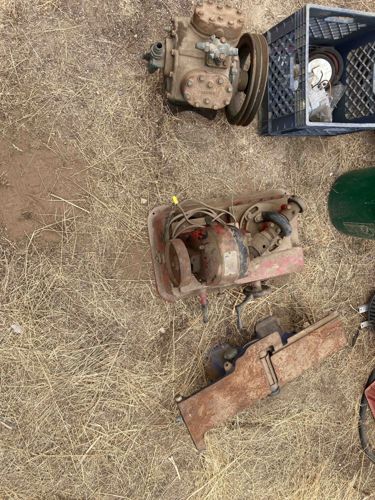
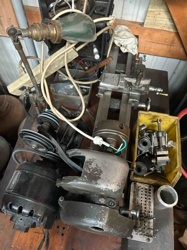
The image displays a collection of three distinct industrial equipment components, likely retired from service, set on a bed of dry grass and dirt. The most prominent component is an air compressor head or refrigerant compressor, characterized by its heavily rusted tan or beige cast iron body. It features multiple bolted sections, visible port connections, and a large, multi-groove pulley wheel on one side, indicating it was belt-driven. The surfaces are caked with dirt and show significant oxidation, suggesting prolonged outdoor exposure. Below and slightly to the left of the compressor is another piece of machinery, appearing to be an electric motor assembly with associated wiring. This component has a red-painted base or housing, now faded and chipped, revealing some underlying metal. Visible elements include a cylindrical motor body, electrical wires (some with yellow connectors), and what might be a centrifugal switch or starter mechanism. Heavy dust and grime are present, along with surface rust on metallic parts. To the lower right is a third, elongated component that appears to be a part of a power tool or machinery attachment, possibly a saw or planer component. It is primarily made of rusted metal, with a flat, board-like section that exhibits a deep reddish-brown oxidation, consistent with severe rust. There are some darker, possibly painted, sections and visible bolts or fasteners. All three items show signs of advanced wear, extensive environmental exposure, and are in a disassembled or removed state, indicating they are either scrap, parts for rebuilding, or intended for salvage. No clear manufacturer's marks or model numbers are discernible. Given their condition and separation, these items appear to be vintage, potentially from the mid to late 20th century. The craftsmanship, particularly of the compressor, suggests robust industrial construction designed for durability.
AI Appraisal Report
I have virtually examined the assorted industrial equipment components presented in the image. This lot comprises a heavily rusted air compressor head, a faded and grimy electric motor assembly, and a severely oxidized, elongated metal component, possibly from a power tool. Their condition is extremely poor: extensive rust, dirt, chipped paint, and signs of prolonged outdoor exposure are evident across all items. Their authenticity as vintage industrial components is visually confirmed by their construction and apparent age; however, without manufacturer marks or serial numbers, specific models or original applications cannot be definitively determined from images alone.
Market conditions for such components are limited. These are not collectible antiques, but rather scrap metal or, at best, parts for highly specialized rebuilds. The primary value lies in their material weight as salvage. Comparables would be other aged, non-functional industrial scrap. There is very low demand for these items in their current state, except perhaps from hobbyists looking for project parts, but even then, the extent of corrosion presents significant refurbishment challenges. Rarity is not a factor here; similar scrap equipment is widely available.
Factors significantly impacting value are their non-operational status, severe degradation, and lack of identifiable features. Their highest and best use is likely scrap. To fully authenticate or assess rebuild potential, I would require an in-person examination to check for internal wear, seize bearings, motor windings integrity, and precise material composition. Provenance documentation would be needed for any claim of specific historical significance, which is unlikely given their current condition. Scientific testing would be excessive for items of this nature and condition.