AI estimate as of September 27, 2025 · verify with a professional before acting
AI-Generated · Verify before acting
Everything on this page is generated by AI for informational purposes only. AI can make mistakes — the AI may misidentify items or misattribute them (artist, maker, brand, designer, origin, era). This is not an official valuation and should not be used for insurance, sale, tax, estate, legal, or lending purposes — or any decision requiring a certified appraisal. It is not an authoritative claim about any person, brand, or rights holder — do not share or rely on it as a factual statement about a third party. Always consult qualified professionals before making financial decisions.
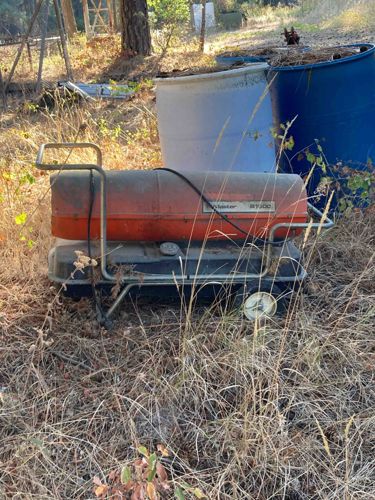
The item is a vintage Wixom model BT300 portable heater, characterized by its distinctive orange cylindrical top housing and a dark, possibly black or dark grey, rectangular base. The heater appears to be constructed primarily of metal, with visible surface rust and discoloration on the orange casing, indicating prolonged exposure to the elements and age. A black hose or cable is draped over the top, further suggesting its utilitarian purpose. The unit is mounted on a rugged metal frame with a pull handle on one end, implying it is designed for portability, possibly using small wheels, though only one small, spoked wheel is partially visible at the bottom right. The 'Wixom' brand name and 'BT300' model number are clearly legible on the orange top housing, printed in white or light-colored lettering. The overall condition suggests significant wear from outdoor storage; there are no clear signs of recent use or maintenance. Its style and robust construction point to an older industrial or agricultural application, likely from the mid to late 20th century. The quality of craftsmanship appears functional and durable, typical of equipment made for demanding environments, though its current external state diminishes its aesthetic appeal and hints at potential internal issues due to neglect.
AI Appraisal Report
I have examined the provided image of the Wixom BT300 Portable Heater. Visually, the unit appears to be an authentic Wixom BT300, consistent with industrial-grade portable heaters from the mid to late 20th century. The orange cylindrical top housing and dark base, along with the clearly legible 'Wixom BT300' lettering, support its identification. The construction, featuring a metal body and a rugged frame with a visible wheel, is typical for equipment designed for demanding environments and portability.
My assessment of its condition is fair to poor. There is significant visible surface rust and discoloration on the orange casing, indicating prolonged outdoor exposure and neglect. The black hose draped over the top is also consistent with utilitarian use but does not provide insight into its functional integrity. This level of external deterioration strongly suggests potential internal issues, such as seized components, fuel system contamination, or electrical faults, which are common for equipment stored outdoors. The lack of recent maintenance is evident.
Market conditions for vintage, non-working industrial heaters are generally low. Comparables would include other used and often non-operational 'barn find' type construction or agricultural heaters. Demand is usually limited to hobbyists, restorers, or individuals seeking parts. This item is not considered rare; while vintage, its utilitarian nature means many were produced, and their value is primarily tied to operational status.
Factors significantly impacting value include its non-operational state (implied by visual condition), the extensive cosmetic deterioration, and the unknown internal mechanical or electrical condition. If fully functional and restored cosmetically, its value would be significantly higher. As it stands, its value is primarily as a restoration project or for parts.
My primary limitation in authenticity verification from images alone pertains to internal components and operational status. An in-person examination would be needed to assess the true extent of corrosion, the condition of the engine/burner, electrical system, and fuel system. I would also check for structural integrity beyond surface rust. Provenance documentation (e.g., original owner manuals, service records) would help confirm its history and potentially original specifications, though this is less critical for a utilitarian item of this type than for collectible art or antiques. Scientific testing is generally not applicable for this item unless there were doubts about material composition, which is not the case here.