These notes were written by the person who submitted this item. Appraiser.AI has not verified them, and the AI's identification and estimate may rely on them.
AI Estimated Value
Not an official valuation
$150-250
AI estimate as of December 7, 2025 · verify with a professional before acting
AI-Generated · Verify before acting
Everything on this page is generated by AI for informational purposes only. AI can make mistakes — the AI may misidentify items or misattribute them (artist, maker, brand, designer, origin, era). This is not an official valuation and should not be used for insurance, sale, tax, estate, legal, or lending purposes — or any decision requiring a certified appraisal. It is not an authoritative claim about any person, brand, or rights holder — do not share or rely on it as a factual statement about a third party. Always consult qualified professionals before making financial decisions.
This analysis also relies on unverified notes provided by the user, which may be incomplete or inaccurate and could affect the result.
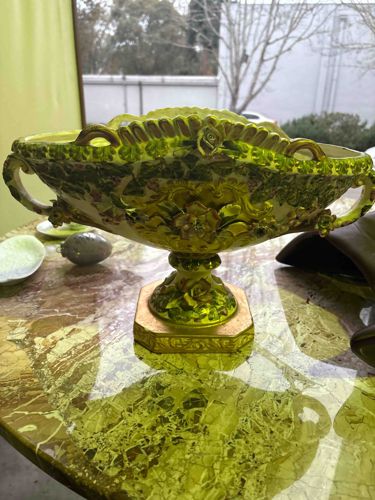
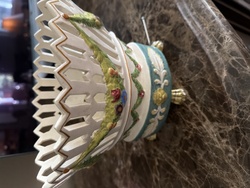
This is a highly ornate ceramic centerpiece bowl, identified as an Ardalt Fiori Antico, likely model 5741, and confirmed to be 'Made in Italy.' The bowl features a two-handled, elongated oval or boat-shaped form, elevated on a substantial pedestal base. The primary color palette is dominated by various shades of green, ranging from a vibrant, almost chartreuse hue to darker, more mossy tones, with occasional hints of cream or light yellow visible within the raised relief decorations. The surface is heavily textured with a rich, three-dimensional 'fiori antico' or 'ancient flowers' motif, prominently featuring blossoms, leaves, and scrolling foliage. This intricate sculptural detailing covers the entire exterior of the bowl, including the handles and the fluted rim, which itself displays a scalloped, almost shell-like pattern along its top edge. The handles are loop-shaped and appear integrated into the overall flow of the botanical relief. The pedestal base is hexadecagonal (sixteen-sided) or octagonal with a stepped design, also adorned with similar green glazes and subtle decorative patterns, providing stability and elevating the main bowl. The glazes appear to be high-gloss, creating a reflective surface that highlights the sculptural details. There are no immediately visible signs of significant damage such as large chips, cracks, or repairs, though a detailed in-person inspection would be needed to confirm. The piece exhibits a maximalist aesthetic, typical of mid-20th century Italian pottery designed for decorative impact. The craftsmanship demonstrates considerable attention to detail in the mold work and hand-applied glazing, indicative of a quality decorative art piece.
AI Appraisal Report
Based on my visual examination of the Ardalt Fiori Antico Two-Handled Centerpiece Bowl with Pedestal Base, model 5741, 'Made in Italy,' I can confirm its authenticity as a mass-produced decorative ceramic piece from the mid-20th century, consistent with the Ardalt Fiori Antico line. The specific model number and 'Made in Italy' mark are crucial for verification. The overall condition appears excellent from the images provided; I don't observe any overt chips, cracks, or repairs, which is a significant factor in maintaining its value. The vibrant green glazes and high-relief floral and foliage motifs are well-preserved, showcasing the typical maximalist aesthetic of these pieces.
Market conditions for Ardalt Fiori Antico pieces show consistent but moderate demand among collectors of vintage Italian ceramics and decorative arts. They are not exceedingly rare, and similar models frequently appear on secondary markets. Comparable sales for well-preserved centerpieces of this scale generally fall within the $100-$300 range, with exceptional examples potentially reaching slightly higher. The intricate detailing and the substantial size of this centerpiece contribute positively, as does the appealing green color variation.
A full authentication beyond visual confirmation would ideally require an in-person examination to assess the precise quality of the glaze, the integrity of the ceramic body, and to meticulously check for hairline cracks, touch-ups, or repairs that might not be visible in photographs. Provenance documentation, though unlikely for pieces of this nature, would further solidify its history. Without physical inspection, I must state that my assessment of condition is based solely on the high-resolution images provided.