AI estimate as of October 25, 2025 · verify with a professional before acting
AI-Generated · Verify before acting
Everything on this page is generated by AI for informational purposes only. AI can make mistakes — the AI may misidentify items or misattribute them (artist, maker, brand, designer, origin, era). This is not an official valuation and should not be used for insurance, sale, tax, estate, legal, or lending purposes — or any decision requiring a certified appraisal. It is not an authoritative claim about any person, brand, or rights holder — do not share or rely on it as a factual statement about a third party. Always consult qualified professionals before making financial decisions.
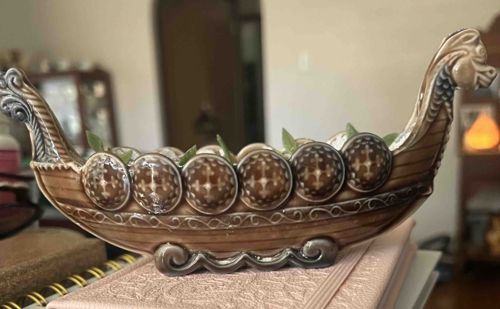
This item is a decorative ceramic piece, crafted in the form of a Viking longship. It appears to be made of glazed ceramic or pottery, exhibiting a warm brown color for the hull, mimicking wood grain with lighter brown and off-white accents for detailing. The vessel features prominent bow and stern elements, with the bow sculpted into the head of a mythical creature, possibly a dragon or serpent, and the stern featuring an elaborate, scrolled design. The creature's head is light tan or off-white with darker brown details suggesting scales or fur, and a distinctive snout and eye area. Along the sides of the 'ship,' there are a series of round, convex elements resembling shields, each decorated with a repeating pattern of crosses or stars in a darker brown tone against a lighter brown background, possibly suggesting a metallic or embossed surface. These 'shields' are uniformly spaced and appear to be integral to the ceramic construction. Below the line of shields, an ornate scrollwork pattern in a lighter, possibly silver or off-white glaze, runs along the 'gunwale' of the ship. The base of the ship is supported by two scrolled feet, also in a similar light tan or off-white glaze with darker accents, giving the impression of waves or stability. Inside the 'ship,' between the 'shields,' there are small green leaf-like elements visible, suggesting that the compartments between the shields could be used to hold small items, potentially plants, candies, or nuts, making it a functional as well as decorative piece. The overall condition appears good, with no visible chips, cracks, or significant wear. The glazes are consistent, indicating a manufactured piece rather than a hand-painted one-off, possibly from the mid to late 20th century, given the style. The craftsmanship is consistent and neat, providing a charming and somewhat whimsical interpretation of a Viking longship.
AI Appraisal Report
Upon visual examination of the provided image, I assess this Ceramic Viking Ship Decorative Centerpiece or Planter to be in good condition. There are no visible chips, cracks, or significant wear apparent in the glazes, which appear consistent across the piece. The uniformity of the glazes and the stylistic elements suggest it is a manufactured item, likely from the mid to late 20th century, rather than a unique, hand-painted artwork. This assessment is based solely on the visual information available; an in-person examination would be required to confirm the absence of hairline cracks, repairs, or manufacturer's marks which could influence authenticity and value.
Market conditions for decorative ceramic items of this nature are generally moderate. Comparables often include similar ornamental ceramic boats, planters, or novelty items from the Vintage/Retro category, frequently found in antique malls, online marketplaces, or estate sales. While charming and well-executed, the demand is typically for home decor or occasional use, not as a rare collectible. The item's likely mass-produced origin limits its rarity; such pieces were common in novelty and giftware lines. Factors impacting value positively include its good condition and endearing design; however, its decorative rather than fine art status and probable mass production prevent it from commanding a high price. The potential functionality as a planter or holder for small items adds to its appeal but doesn't significantly elevate its monetary value beyond the decorative art market.
Limitations: Without physical inspection, I cannot verify the type of ceramic (e.g., earthenware, stoneware), the specific glaze quality beyond visual appearance, or the presence of any maker's marks or identifying labels that would confirm origin and age. Such details, along with any provenance documentation, would be crucial for a definitive authentication and a more precise valuation.