AI estimate as of August 27, 2025 · verify with a professional before acting
AI-Generated · Verify before acting
Everything on this page is generated by AI for informational purposes only. AI can make mistakes — the AI may misidentify items or misattribute them (artist, maker, brand, designer, origin, era). This is not an official valuation and should not be used for insurance, sale, tax, estate, legal, or lending purposes — or any decision requiring a certified appraisal. It is not an authoritative claim about any person, brand, or rights holder — do not share or rely on it as a factual statement about a third party. Always consult qualified professionals before making financial decisions.
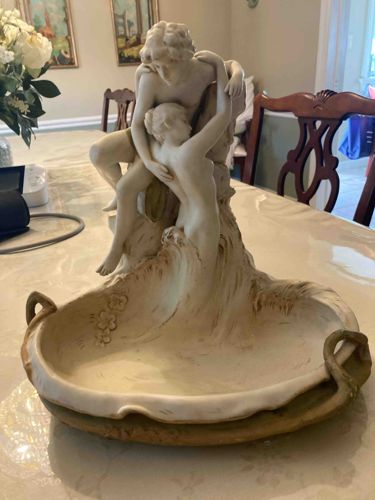
This appears to be a large, figural ornamental centerpiece or compote, likely crafted from bisque porcelain or a similar ceramic material, designed in a style reminiscent of Art Nouveau or early 20th-century aesthetics. The statuette portion depicts two intertwined allegorical figures, possibly nymphs or cherubs, with one figure seemingly supporting or embracing the other. Their bodies are gracefully sculpted, and the details of their hair and facial features suggest a classical influence. The color palette is muted, primarily off-white or cream for the figures, with subtle hints of light brown or beige in the base and possibly in some contoured areas to give depth and texture, potentially mimicking natural elements like wood or rock where the figures are situated. The base of the piece transitions into a large, wave-like or shell-shaped bowl with undulating edges, forming a functional holder. This bowl features two scrolled handles, one on each side, integrated into its design. Small, delicate floral motifs, possibly poppies or similar blooms, are visible on the interior of the bowl, adding a picturesque detail. The construction appears to be molded, with excellent craftsmanship visible in the flowing lines and anatomical accuracy of the figures. There appears to be a slight patina consistent with age and exposure, but no obvious significant chips, cracks, or repairs are immediately discernible from the image, indicating good condition overall for its presumed age. The sculptural quality and detailing suggest a manufacturer focused on artistic expression and high-quality production.
AI Appraisal Report
Upon visual examination of this Figural Bisque Porcelain Centerpiece with Wave Bowl, I'm struck by its elegant design and apparent craftsmanship. The piece appears to be in good overall condition, with a pleasing patina consistent with age, suggesting no major chips, cracks, or repairs are immediately evident from the image. The intricate detailing of the allegorical figures and the delicate floral motifs within the bowl speak to a high level of artistry.
Based on its style, materials, and apparent quality, this centerpiece likely dates to the late 19th or early 20th century, possibly from a European manufacturer. Market conditions for decorative bisque porcelain of this period can vary, but well-preserved, aesthetically pleasing examples with good sculptural quality generally retain value. Comparables would include other high-quality bisque or parian ware centerpieces, often featuring classical or allegorical themes. While not exceptionally rare, pieces of this size and detail, especially those without significant damage, are less common than smaller decorative bisque items.
Factors significantly impacting value include the manufacturer (if identifiable, especially prominent European houses), the exact age, and the overall condition. The sculptural quality and functional bowl aspect add to its appeal. Without a physical inspection, authentication is limited. I cannot conclusively determine the exact porcelain type (e.g., true bisque vs. parian), confirm the absence of hairline cracks or professional restorations not visible in the image, or identify any maker's marks, which are crucial for definitive authentication and precise valuation. An in-person examination, coupled with potential UV light testing for repairs and research into any visible marks/provenance, would be necessary for a full, verifiable appraisal. Despite these limitations, it presents as a desirable decorative art object.