AI Appraisal Estimate

AI-generated estimates · not official valuations

From the user

What was submitted

Photo and notes provided by the user — not generated by AI

Submitted item photo
Submitted photo · June 1, 2026

User's notes

No additional notes provided.

AI analysis below

AI appraisal

AI analysis & estimate

AI-Generated · Verify before acting

Everything below is generated by AI for informational purposes only. AI can make mistakes — the AI may misidentify items or misattribute them (artist, maker, brand, designer, origin, era). This is not an official valuation and should not be used for insurance, sale, tax, estate, legal, or lending purposes — or any decision requiring a certified appraisal. It is not an authoritative claim about any person, brand, or rights holder — do not share or rely on it as a factual statement about a third party. Always consult qualified professionals before making financial decisions.

Read the full disclaimer

AI Identification

·Not independently authenticated·Verify before acting

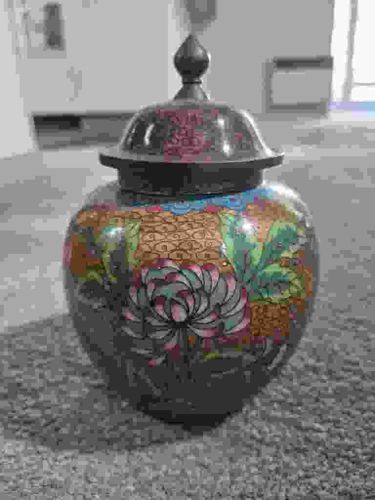
Lidded Chinese Cloisonné Ginger Jar

Asian Antiques & Decorative Arts

AI Estimated Value

·Not an official valuation·Verify before acting

$450 - $650

As of June 1, 2026

AI Item Analysis

·AI can make mistakes·Verify before acting
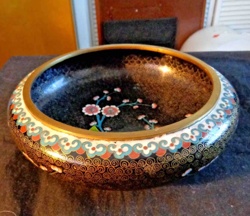
This is a globular-shaped lidded ginger jar or urn featuring intricate cloisonné enamel work over a brass or bronze metal body. The pot is decorated with a vibrant polychrome floral motif, primarily featuring a large, stylized chrysanthemum blossom in shades of pink, white, and teal. The background is composed of a complex 'thousand flowers' or interlocking cloud pattern in gold and earth tones, framed by deep blue scrollwork along the upper shoulder. The lid is domed with a flattened rim and is topped with a distinct pointed finial, likely made of patinated brass or bronze. The craftsmanship demonstrates the traditional wire-inlay technique where fine metal wires partition different colored enamel pastes. Regarding condition, the metal components on the lid show a dark, aged patina, and there appears to be some minor pitting or loss of luster in the enamel surface, consistent with a mid-20th-century vintage. No obvious cracks or structural damage are visible in the image, though surface oxidation on the exposed metal rims indicates significant age. This piece likely hails from the Republic period or is a high-quality mid-century export piece, showcasing classic Chinese decorative arts aesthetic.
AI Appraisal Report

·AI can make mistakes·Verify before acting
I have carefully examined the visual characteristics of this lidded cloisonné ginger jar. The piece exhibits a 'thousand flowers' (wan hua) motif executed with fine wire-work on a brass substrate. The stylized chrysanthemum and the scrollwork on the shoulder are characteristic of quality export wares from the early to mid-20th century. Based on the visible patina on the finial and the minor surface oxidation on the rims, this item appears to be a genuine vintage piece, likely from the Republic period (1912–1949) or a high-quality mid-century successor. Market demand for Chinese cloisonné remains steady, though values are highly dependent on the fineness of the cloisons and the lack of pitting. The 'thousand flowers' pattern is a desirable aesthetic for collectors of Asian decorative arts. Comparables for similar jars of this size and era typically hammer between $400 and $700 at regional auction houses. Factors impacting value include the intact domed lid and the complexity of the polychrome palette. Please note: A definitive authentication cannot be performed via images alone. Without physical inspection, I cannot confirm the presence of concealed repairs, the exact composition of the metal alloy, or the presence of a maker's mark on the underside. A full authentication would require an in-person examination to check for enamel 'bubble' depth and weight-to-size ratio. Provenance documentation, such as original purchase receipts or import records, would significantly enhance market value. For an absolute determination of age, thermoluminescence (TL) testing of any remaining kiln firing core material would be required, though it is rarely cost-effective for decorative pieces of this valuation range.

Get your items appraised

Instant estimates of your treasures with AI-powered appraisals

Browse More Appraisals