AI estimate as of November 9, 2025 · verify with a professional before acting
AI-Generated · Verify before acting
Everything on this page is generated by AI for informational purposes only. AI can make mistakes — the AI may misidentify items or misattribute them (artist, maker, brand, designer, origin, era). This is not an official valuation and should not be used for insurance, sale, tax, estate, legal, or lending purposes — or any decision requiring a certified appraisal. It is not an authoritative claim about any person, brand, or rights holder — do not share or rely on it as a factual statement about a third party. Always consult qualified professionals before making financial decisions.
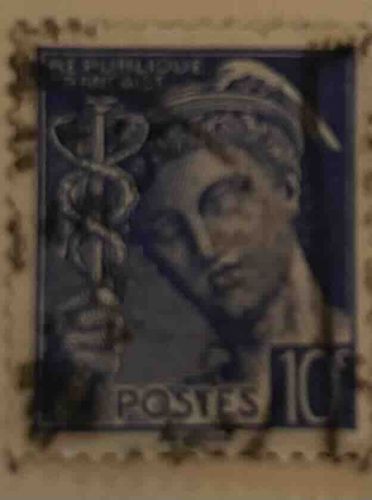
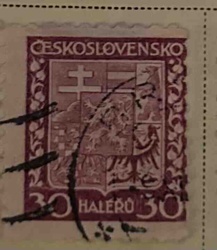
This appears to be a vintage French postage stamp, characterized by a predominantly blue-grey color palette with a textured, probably paper, material. The stamp features a central vignette depicting a bust of Mercury (Hermes in Greek mythology), typically associated with the Semeuse (Sower) type issues, although Semeuse stamps generally depict a female figure. In this specific image, the male head with a winged helmet strongly suggests Mercury. The figure is shown in profile or three-quarter view, looking towards the right side of the stamp. He holds a caduceus, identifiable by the two serpents entwined around a winged staff, in his left hand. The upper left corner bears the inscription 'R'PUBLIQUE FRAN'AISE' (Republic of France), though it is partially obscured and difficult to read clearly due to blurriness. Near the bottom, the word 'POSTES' is visible, indicating its function as a postal stamp. To the bottom right, the denomination '10C' (10 Centimes) is clearly legible. The stamp exhibits characteristic perforated edges, typical of postage stamps, though the edges appear somewhat worn or uneven in places. The overall condition suggests some age and handling, with possible slight discoloration on the margins. The printing quality, despite the image's resolution, indicates a fine engraving or lithography process typical of early to mid-20th-century postal issues. The exact date cannot be determined from the image alone, but the design style points to an early 20th-century origin, likely from the period when Mercury head designs were used in France, possibly between the 1920s and 1940s, or even earlier as a variant of the Sower series.
AI Appraisal Report
Upon visual examination of the provided image, I assess this French Mercury Head Stamp (Semeuse Type), denominated '10C', to be authentic based on its design, inscriptions, and characteristic perforated edges consistent with French postal issues of the early-to-mid 20th century. While the Semeuse series typically features a female figure, the Mercury head was also utilized, often for definitive issues. The stamp exhibits fair to good condition, showing signs of age and handling, including what appears to be slight discoloration and uneven perforations. The printing quality seems adequate for its era.
From a market perspective, French definitive stamps of this period, particularly common denominations like 10 Centimes, are generally not rare unless they possess specific varieties (e.g., paper types, watermarks, printing errors) or are in mint, unhinged condition. Based on the visible wear, this stamp is likely used or has been handled. Comparables for a common, used 10c Mercury Head stamp typically range from a few dollars to perhaps twenty dollars, depending heavily on the precise catalog number and actual condition. The blurred 'R’PUBLIQUE FRAN’AISE' and general image resolution limit definitive assessment of fine details critical for variety identification.
Demand for common French definitives is generally moderate among collectors. Without physical inspection, I cannot verify specific paper types, watermarks, gum condition (if unused), or plate flaws that could significantly impact value. For full authentication and to ascertain any rare varieties, a hands-on examination by a philatelic expert, ideally with access to specialized equipment for watermark detection and measurement, and comparison with known catalog varieties, would be essential. Provenance documentation, though less critical for common issues, would also add value.
Given its visible condition and likely common status, I estimate the appraisal value to be between $5 and $15.