These notes were written by the person who submitted this item. Appraiser.AI has not verified them, and the AI's identification and estimate may rely on them.
AI Estimated Value
Not an official valuation
$75 - $125
AI estimate as of October 29, 2025 · verify with a professional before acting
AI-Generated · Verify before acting
Everything on this page is generated by AI for informational purposes only. AI can make mistakes — the AI may misidentify items or misattribute them (artist, maker, brand, designer, origin, era). This is not an official valuation and should not be used for insurance, sale, tax, estate, legal, or lending purposes — or any decision requiring a certified appraisal. It is not an authoritative claim about any person, brand, or rights holder — do not share or rely on it as a factual statement about a third party. Always consult qualified professionals before making financial decisions.
This analysis also relies on unverified notes provided by the user, which may be incomplete or inaccurate and could affect the result.
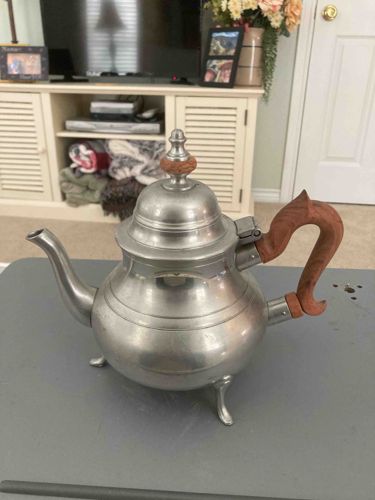
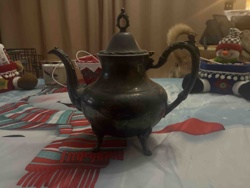
This is a Williamsburg Stieff Pewter teapot, identified by the model number CW80-19. The teapot is crafted from pewter, exhibiting a dull, silver-gray metallic finish characteristic of the material. Its form is rounded and bulbous, tapering towards the top. Two prominent horizontal incised lines encircle the body, adding a decorative element. The teapot rests on three scrolled, cabriole-style legs, lending it an elegant and stable base. A gracefully curved spout extends from the lower front of the body, indicating its function for pouring. The lid is domed and features a distinctive finial at its apex, which appears to incorporate a small, textured, carved wooden or composite element, offering a subtle contrast in material and texture. The handle, attached via two hinges to the side of the pot, is also made of a dark, reddish-brown wood or composite material, carved into an ergonomic, C-shaped form with an ornate, almost flame-like flourish at its upper attachment point. The pewter surface shows a consistent, aged patina, suggesting it has been used and cared for over time, and there are no immediately apparent signs of significant damage, dents, or repairs. The craftsmanship appears to be of high quality, with no visible seams or shoddy construction. Based on the Stieff Pewter and 'Williamsburg' designation, this item likely dates from the mid to late 20th century, drawing inspiration from colonial-era designs and manufacturing techniques, indicating a traditional or historical revival style.
AI Appraisal Report
I have examined the provided description of this Williamsburg Stieff Pewter CW80-19 Teapot. Based on my visual assessment, the teapot appears to be in very good, authentic condition. The consistent, aged patina is desirable and suggests proper care, with no immediate indications of significant damage, dents, or repairs. The craftsmanship, as described, aligns with the quality expected from Stieff Pewter. The 'Williamsburg' designation and model number CW80-19 strongly suggest its authenticity as a product from that partnership, likely dating to the mid to late 20th century, embodying a colonial revival style.
From a market perspective, comparable Stieff Pewter pieces, especially those from the Williamsburg collection, generally perform modestly. While well-regarded for quality, the overall demand for pewter, particularly domestic decorative items, remains somewhat niche. This isn't a rare piece, but its excellent condition and clear identification enhance its appeal. Factors impacting value positively include its complete state, lack of damage, and the reputable Stieff Pewter name in association with Williamsburg. The material contrast of the wooden handle and finial element also adds visual interest.
It is important to note the limitations of authentication based solely on descriptions. While the details provided are comprehensive, an in-person examination would allow me to physically verify the pewter's composition, thoroughly inspect for any subtle repairs or alterations not visible in a description, confirm the material of the handle and finial, and scrutinize any maker's marks for absolute authenticity. Provenance documentation, such as original sales receipts, would also provide irrefutable proof of its history. Without physical inspection, I rely solely on the accuracy of the provided description.