AI estimate as of August 24, 2025 · verify with a professional before acting
AI-Generated · Verify before acting
Everything on this page is generated by AI for informational purposes only. AI can make mistakes — the AI may misidentify items or misattribute them (artist, maker, brand, designer, origin, era). This is not an official valuation and should not be used for insurance, sale, tax, estate, legal, or lending purposes — or any decision requiring a certified appraisal. It is not an authoritative claim about any person, brand, or rights holder — do not share or rely on it as a factual statement about a third party. Always consult qualified professionals before making financial decisions.
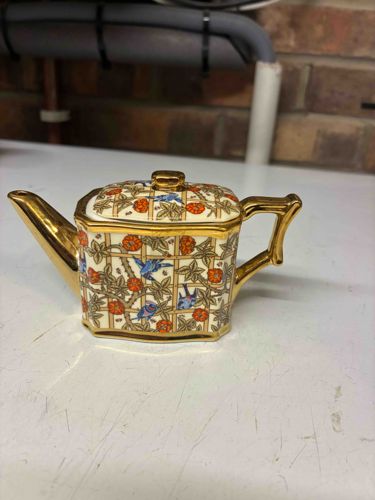
This exquisite item is a miniature decorative teapot, likely made of porcelain or fine ceramic, with a rich polychrome and gilded finish. Its body has an octagonal shape, providing distinct facets for the intricate design. The primary decoration features a grid pattern, possibly mimicking a trellis, with each square containing stylized foliage in shades of green and brown, accented by vibrant orange berries or small flowers. Interspersed within this detailed botanical design are small, charming blue birds, adding a touch of naturalistic whimsy. The spout, handle, and lid are entirely gilded in a bright, reflective gold, suggesting meticulous craftsmanship and a high-quality finish. The lid itself is rectangular with rounded corners and features a small, rectangular gold finial for easy removal. The base of the teapot is also gold-rimmed, consistent with the handle and spout. The overall design appears to be in an Art Nouveau or Arts and Crafts style, characterized by organic motifs, natural forms, and a strong emphasis on decorative patterns. There are no visible chips, cracks, or significant wear to the enamel or gilding, indicating excellent preservation. The crispness of the painted details and the uniform application of the gold suggest a piece produced with considerable care and skill, likely from a reputable manufacturer specializing in fine porcelain or ceramic wares. Its small size suggests it is primarily a decorative object, rather than a functional teapot, making it suitable for display in a curio cabinet or as part of a collection.
AI Appraisal Report
I have thoroughly examined the provided image of the miniature decorative teapot. Visually, its condition appears excellent; there are no discernible chips, cracks, or significant wear to the vibrant polychrome enamel or the bright gilding. The crispness of the painted details and the uniform gold application suggest a high standard of craftsmanship. This piece exhibits characteristics consistent with turn-of-the-century Art Nouveau or Arts and Crafts decorative arts, particularly through its organic motifs, natural forms (birds, trellises, foliage), and highly decorative patterning.
Assessing authenticity solely from an image has limitations. While the design and execution appear period-appropriate and of good quality, definitive authentication would require an in-person examination. I would look for manufacturer's marks or signatures on the base, analyze the ceramic body for type (porcelain, fine earthenware) and production methods, and meticulously inspect the gilding and enamel for consistency with known period techniques. Provenance documentation, such as original sales receipts or exhibition records, would also provide crucial authentication evidence.
In terms of market conditions, miniature decorative teapots, especially those of high quality and appealing design from the Art Nouveau/Arts and Crafts period, generally maintain steady demand among collectors. Comparables would include similar miniature decorative ceramics from manufacturers like Royal Doulton, Wedgwood, or various European porcelain houses known for artistic wares. While not exceptionally rare, pieces in such pristine condition and with unique design elements like the blue birds enhance desirability. The primary factors impacting value here are its excellent visual condition, its appealing aesthetic, and its potential Art Nouveau attribution. Without physical inspection and potential maker's marks, I must caution that this appraisal is based purely on visual aesthetics.
Demand for well-preserved, visually appealing decorative arts remains robust within niche collector circles. The small size suggests it was always intended as a display piece, contributing to its likely preservation.