AI Appraisal Estimate

AI-generated estimates · not official valuations

From the user

What was submitted

Photo and notes provided by the user — not generated by AI

Submitted item photo
Submitted photo · June 25, 2026

User's notes

No additional notes provided.

AI analysis below

AI appraisal

AI analysis & estimate

AI-Generated · Verify before acting

Everything below is generated by AI for informational purposes only. AI can make mistakes — the AI may misidentify items or misattribute them (artist, maker, brand, designer, origin, era). This is not an official valuation and should not be used for insurance, sale, tax, estate, legal, or lending purposes — or any decision requiring a certified appraisal. It is not an authoritative claim about any person, brand, or rights holder — do not share or rely on it as a factual statement about a third party. Always consult qualified professionals before making financial decisions.

Read the full disclaimer

AI Identification

·Not independently authenticated·Verify before acting

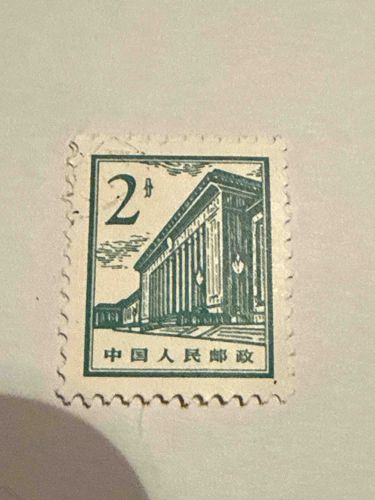
1959 People's Republic of China 2 Fen Gilt/Green Postage Stamp (Ten Great Buildings Series)

Philately / Postage Stamps

AI Estimated Value

·Not an official valuation·Verify before acting

$5.00 - $12.00

As of June 25, 2026

AI Item Analysis

·AI can make mistakes·Verify before acting
This is a vertical rectangular postage stamp from the People’s Republic of China, part of the 1959-1960 series commemorating the 'Ten Great Buildings' in Beijing built for the 10th anniversary of the PRC. The stamp features an intaglio-printed architectural illustration of the Great Hall of the People in a deep slate green or bluish-green ink on an off-white, cream-toned paper. The upper left corner prominently displays the denomination '2 fen'. At the bottom, a horizontal banner contains the dark-colored Chinese inscription '中国人民邮政' (China People’s Post). The central image showcases the Neoclassical architectural style of the building, emphasizing its massive columns and perspective. Physically, the stamp features standard perforations on all four sides. The centering is slightly shifted toward the top right edge. Regarding condition, there is evidence of post-consumer handling; visible wear includes slightly blunted perforation tips, a faint vertical crease near the bottom center, and some mild surface foxing or toning consistent with its age of over 60 years. No postmark cancel is visible in the provided image, suggesting it may be in unused (mint) condition, though the reverse gum state cannot be determined from this view. The print quality demonstrates fine line engraving characteristic of state security printing of the late 1950s.

AI Appraisal Report

·AI can make mistakes·Verify before acting
I have conducted a visual examination of this 1959 2 Fen stamp from the Ten Great Buildings series, depicting the Great Hall of the People. The stamp exhibits the characteristic intaglio printing and deep slate green ink consistent with late 1950s Chinese state production. Condition analysis reveals several points of concern that limit its technical grade: the centering is significantly shifted to the upper-right, and I observe blunted perforations along with a visible vertical crease near the lower margin. The presence of surface foxing and toning suggests storage in a high-humidity environment, which common for philatelic material of this period. While the absence of a postal cancellation suggests an unused state, the actual value is heavily dependent on the reverse gum; a 'Mint Never Hinged' (MNH) example commands a premium, whereas a 'Mint Hinged' (MH) or 'No Gum' (NG) copy sits at the lower end of the valuation scale. Market demand for early PRC issues remains steady, particularly among regional collectors, but this specific denomination was mass-produced, making it common in the current secondary market. High-grade, perfectly centered examples of this series fetch higher prices, but the noted defects here categorize this as a 'filler' or 'collector-grade' copy. This appraisal is based strictly on high-resolution imagery. A definitive authentication would require physical inspection to verify paper thickness, watermark (if applicable), and gum veracity. Microscopic examination of the engraving lines and UV-light testing would be necessary to rule out modern reprints or sophisticated repairs.

Get your items appraised

Instant estimates of your treasures with AI-powered appraisals

Browse More Appraisals