AI Appraisal Estimate

AI-generated estimates · not official valuations

From the user

What was submitted

Photo and notes provided by the user — not generated by AI

Submitted item photo
Submitted photo · May 26, 2026

User's notes

No additional notes provided.

AI analysis below

AI appraisal

AI analysis & estimate

AI-Generated · Verify before acting

Everything below is generated by AI for informational purposes only. AI can make mistakes — the AI may misidentify items or misattribute them (artist, maker, brand, designer, origin, era). This is not an official valuation and should not be used for insurance, sale, tax, estate, legal, or lending purposes — or any decision requiring a certified appraisal. It is not an authoritative claim about any person, brand, or rights holder — do not share or rely on it as a factual statement about a third party. Always consult qualified professionals before making financial decisions.

Read the full disclaimer

AI Identification

·Not independently authenticated·Verify before acting

Decoupage Wall Clock featuring 'Grace' Imagery

Wall Clocks

AI Estimated Value

·Not an official valuation·Verify before acting

$25-$60

As of May 26, 2026

AI Item Analysis

·AI can make mistakes·Verify before acting
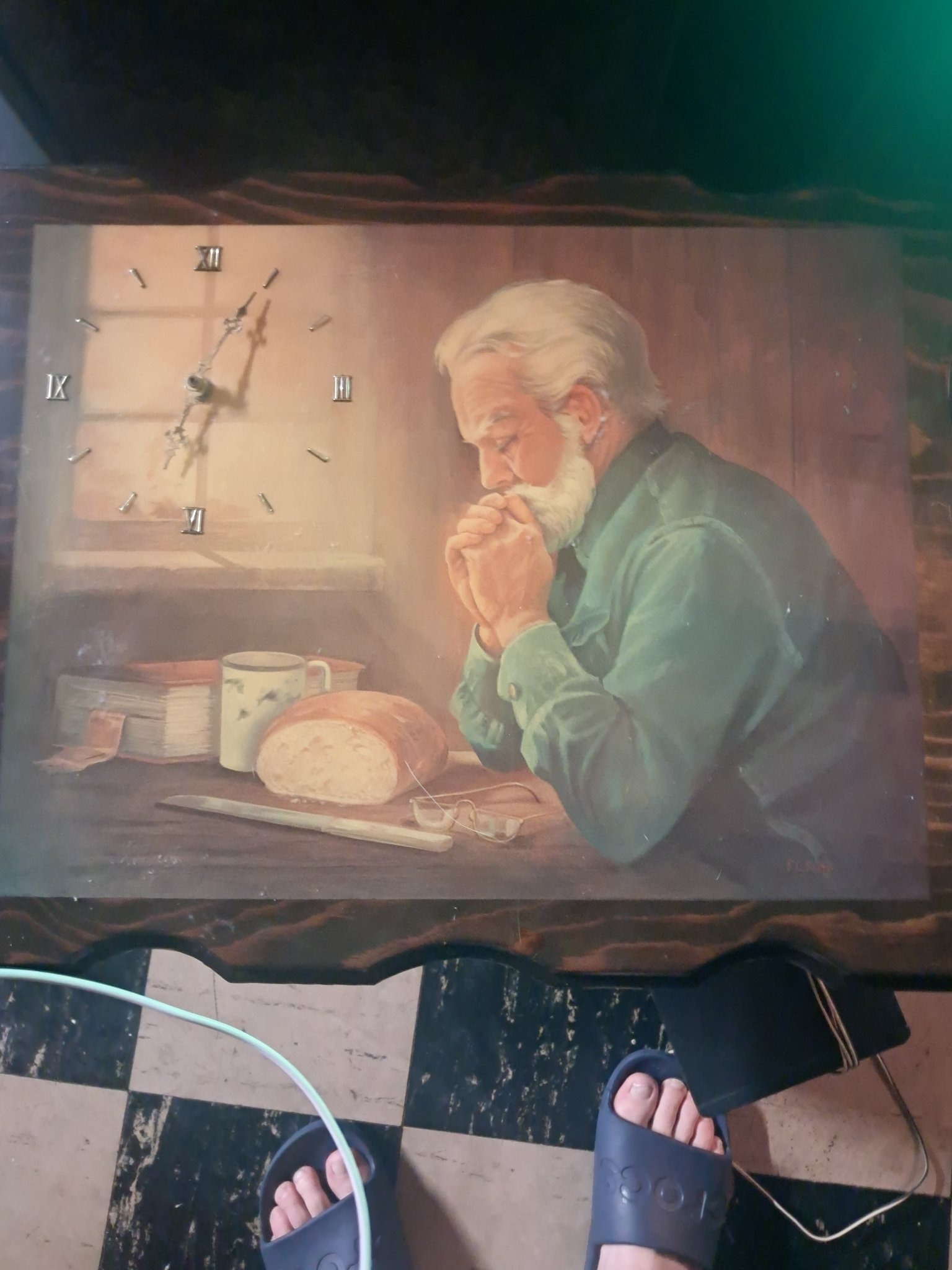
This item is a functional wall clock featuring a printed reproduction of the well-known 'Grace' motif, which depicts an elderly bearded man with clasped hands saying a prayer over a humble meal of bread. Stylistically, the image is consistent with the famous 1918 photograph by Eric Enstrom, later painted in oil by his daughter, Rhoda Nyberg. In the lower right corner, there appears to be a small signature or mark that is difficult to decipher from the image but may be consistent with 'R. Nyberg' as marked. The image has been applied to a wooden plaque with decoratively scalloped edges, likely through a decoupage process. A battery-operated clock mechanism has been integrated into the upper left quadrant, using the window in the background of the image as the dial. The clock features Roman numerals at the XII, III, VI, and IX positions, with simple batons for the other hours; the hands are ornate, silver-toned filigree. The overall aesthetic is consistent with mid-to-late 20th-century home decor produced for the religious market. The wooden surface shows a dark, lustrous finish with some visible grain patterns and minor edge wear. The identification is hedged because mass-produced decorative clocks often use licensed artwork, and physical inspection would be required to determine if the base image is a print, a mechanical reproduction, or an original painting (though the integration of clock hardware suggests a commercial reproduction).
AI Appraisal Report

·AI can make mistakes·Verify before acting
I have examined the image provided of the decoupage wall clock featuring the 'Grace' motif. Based on what I can see, the item appears to be a mass-produced decorative piece likely dating from the mid-to-late 20th century. The imagery bears a signature consistent with R. Nyberg, suggesting it utilizes the licensed reproduction of the 1918 photograph by Eric Enstrom. However, I cannot verify from a photo whether the image is a high-quality print or a mechanical reproduction integrated into the wooden plaque. The clock’s value is primarily dictated by its condition and its appeal as a piece of religious Americana. The wooden base shows some edge wear and a lustrous finish, which is typical for items of this vintage. Market demand for these particular motifs remains steady but modest within the secondary market for religious decor and vintage kitchenware. The provided estimate assumes the clock mechanism is functional and that the attribution to the Nyberg/Enstrom imagery is accurate for a commercial reproduction. I cannot assert the specific manufacturer without seeing a label on the reverse, which often dictates a more precise market position. If this were to be identified as a contemporary or low-quality replica rather than a vintage mid-century piece, the value would likely fall toward the lower end of the range. To confirm the specific era of manufacture and the nature of the image application, a physical inspection would be required to examine the clock movement and the depth of the decoupage layers. Documentation of provenance or an original manufacturer's sticker would also assist in refining this estimate.

Get your items appraised

Instant estimates of your treasures with AI-powered appraisals

Browse More Appraisals