AI estimate as of October 31, 2025 · verify with a professional before acting
AI-Generated · Verify before acting
Everything on this page is generated by AI for informational purposes only. AI can make mistakes — the AI may misidentify items or misattribute them (artist, maker, brand, designer, origin, era). This is not an official valuation and should not be used for insurance, sale, tax, estate, legal, or lending purposes — or any decision requiring a certified appraisal. It is not an authoritative claim about any person, brand, or rights holder — do not share or rely on it as a factual statement about a third party. Always consult qualified professionals before making financial decisions.
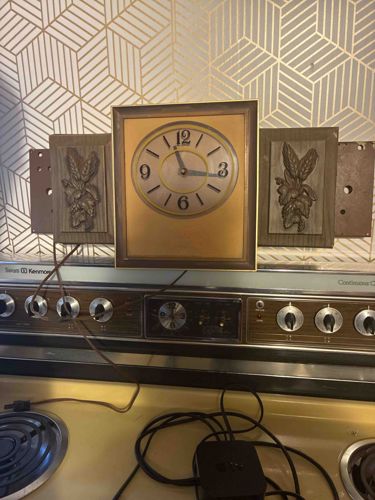
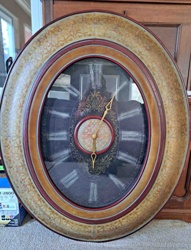
This item is a vintage wall clock, likely from the mid-20th century, characterized by its rectangular central clock face and two flanking decorative wood panels. The clock itself is housed within a light-colored wooden frame, possibly a veneer, with a slightly darker, contrasting border around the face. The clock face is round, featuring a cream or light gold background with dark, stylized Arabic numerals (3, 6, 9, 12 prominently) and dash marks for the other hours. The hands appear to be a simple, dark metal. The overall aesthetic of the clock face suggests a clean, possibly Art Deco-influenced or early mid-century design. One notable detail on the clock face is a small marking that appears to be '12/' above the '12' numeral and '/61' below the '6' numeral, which might suggest a date (e.g., December 1961) or a model number. The two side panels are rectangular and made of what appears to be a carved or molded dark wood, or a material designed to mimic carved wood. Each panel features a design of foliage, possibly wheat stalks or similar agricultural motifs, suggesting a rustic or traditional theme. The panels seem to be attached to a darker, more utilitarian rectangular piece of wood or metal on their outer edges, which has visible holes, indicating that these might have been used for mounting or attachment to a larger structure. The entire piece has a warm, aged patina consistent with its likely vintage. There are no visible signs of significant damage like cracks or major chipping, though general wear and tear from age would be expected. The craftsmanship appears to be functional and decorative, typical of mass-produced home decor items from its era. The wood grain on the frame appears smooth, while the decorative panels have a textured, sculptural quality.
AI Appraisal Report
I've examined the provided image of this vintage wall clock with decorative wood panels. Based on its appearance, I assess its condition as good vintage, showing expected wear and an aged patina consistent with its mid-20th-century likely origin, possibly December 1961 as indicated by the '12/ /61' marking. There are no visible major damages like cracks or significant chips, suggesting it has been reasonably well-preserved. Authenticity as a period piece seems plausible given the design cues—Art Deco or early mid-century aesthetic on the clock face combined with the more traditional, possibly rustic, carved wood panels. This mix of styles was common for mass-produced home decor of the era aiming for broad appeal.
In terms of market conditions, vintage wall clocks from this period are generally considered decorative items rather than highly collectible horological pieces, unless they are from a renowned manufacturer, which is not evident here. Comparables typically fall into the modest range, especially for functional but not exceptional design. Demand for such clocks is steady among vintage decor enthusiasts but rarely reaches premium prices. Rarity is low; similar styles were produced in large quantities.
Factors impacting value include its good aesthetic condition and functional vintage appeal. The most significant limitation in this appraisal is the lack of physical examination. I cannot verify the clock's working mechanism, the material quality of the 'carved' panels (e.g., if they are solid wood, composite, or resin), or the true composition of the main frame without an in-person inspection. Furthermore, determining the manufacturer and verifying the '12/ /61' as a date or model number requires direct examination or provenance documentation. Scientific testing would be excessive for an item of this likely value. The current appraisal is based solely on visual cues from the image.