AI estimate as of December 15, 2025 · verify with a professional before acting
AI-Generated · Verify before acting
Everything on this page is generated by AI for informational purposes only. AI can make mistakes — the AI may misidentify items or misattribute them (artist, maker, brand, designer, origin, era). This is not an official valuation and should not be used for insurance, sale, tax, estate, legal, or lending purposes — or any decision requiring a certified appraisal. It is not an authoritative claim about any person, brand, or rights holder — do not share or rely on it as a factual statement about a third party. Always consult qualified professionals before making financial decisions.
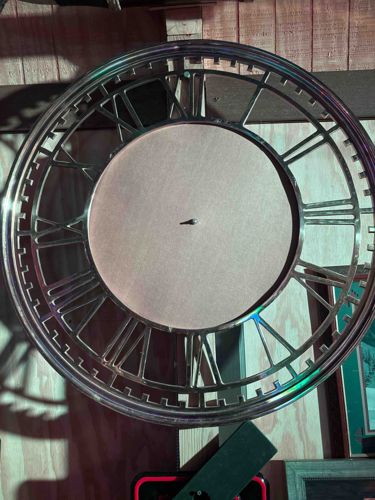
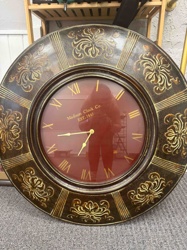
This appears to be a large, circular wall clock face, characterized by a skeletal design that prominently features Roman numerals. The primary material is a highly polished metal, likely chrome or a similar reflective alloy, exhibiting a silver tone and some iridescent reflections, particularly noticeable in the lower right quadrant. The outer rim is substantial, with the Roman numerals (I through XII) intricately cut out or formed within the metallic frame. The absence of hour and minute hands suggests it might be awaiting completion or is designed to allow the underlying wall to serve as part of its aesthetic. The central circular area, where a clock mechanism would typically be housed, is a plain, light-colored surface, possibly cardboard, thin wood, or a matte plastic, with a single central mounting point visible, indicating where hands would attach. The construction appears sturdy, with clean lines and precise cuts for the numerals, suggesting a machine-cut or well-cast piece. Given its size and visible design, it functions primarily as a decorative art piece, offering a contemporary or industrial aesthetic. There are no obvious signs of significant wear, damage, or repairs, and its reflective surface appears well-maintained. The item's age is difficult to determine without further context, but the style is consistent with modern decorative wall clocks, likely manufactured within the last few decades. The craftsmanship, while not showcasing delicate hand carving, demonstrates good manufacturing quality in its finish and structural integrity.
AI Appraisal Report
This skeletal Roman Numeral Wall Clock presents as a modern decorative piece, likely manufactured from chrome or a similar reflective alloy. My visual examination indicates very good condition; the polished metal surface shows no obvious scratches, dents, or tarnishing. The precision of the cut-out Roman numerals and the overall clean lines suggest good manufacturing quality, likely machine-produced rather than handcrafted. It appears complete, despite the absence of hands, as many such decorative skeletal clocks are designed without them, or the hands are a separate, interchangeable component. The central core, a plain light-colored surface, is consistent with contemporary mass-produced decor.
From a market perspective, similar new decorative wall clocks, often made from metal, range widely, but pieces of this aesthetic and material quality typically retail for $50-$150. There is no inherent rarity; this style is broadly available from various home decor retailers. Demand for such items is generally good for accent pieces in contemporary interiors. The primary value drivers are its decorative appeal, size, and material. Given that it lacks a functional clock mechanism (hands), which would often house the actual time-keeping movement, its value is purely aesthetic and decorative.
Limitations on authenticity verification are significant. Without physical inspection, I cannot confirm the exact metal composition, the origin of manufacture, or the true age. An in-person examination would allow me to test the metal, ascertain its weight and construction details more thoroughly, and check for manufacturer marks, which would be crucial for determining if it's a higher-end designer piece versus a widely available decor item. Provenance documentation would be useful if it were a branded item, but for general decor, it's less critical. Scientific testing is not typically applied to items of this nature.