AI estimate as of August 16, 2025 · verify with a professional before acting
AI-Generated · Verify before acting
Everything on this page is generated by AI for informational purposes only. AI can make mistakes — the AI may misidentify items or misattribute them (artist, maker, brand, designer, origin, era). This is not an official valuation and should not be used for insurance, sale, tax, estate, legal, or lending purposes — or any decision requiring a certified appraisal. It is not an authoritative claim about any person, brand, or rights holder — do not share or rely on it as a factual statement about a third party. Always consult qualified professionals before making financial decisions.
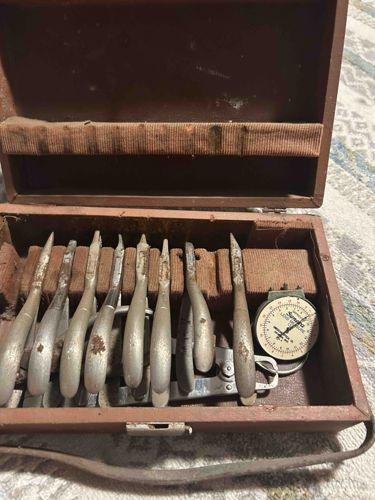
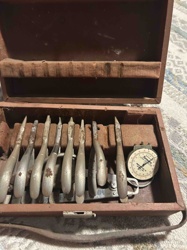
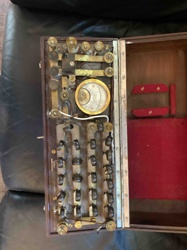
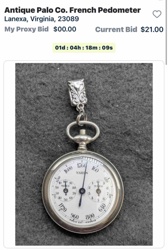
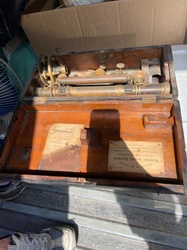
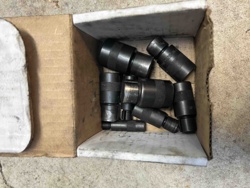
This appears to be an antique or vintage set of dental tools, likely used for tooth extraction, housed in a fitted wooden case. The case itself is made of dark, possibly stained, wood with a hinged lid. The interior of the lid is lined with a dark, textured fabric, likely velvet or a similar material, which shows significant wear, dust, and discoloration, suggesting age and use. The base of the case is also fitted with compartments, lined with the same dark fabric, designed to hold each tool securely. There are at least nine distinct tools visible, made of what appears to be a rust-prone metal, possibly steel or iron, given the visible surface corrosion and pitting. Each tool has a rounded, ergonomic handle, designed for grip, tapering to various shapes of working ends, suggesting different applications for extracting teeth. These working ends show signs of wear and minor deformation. The overall condition of the tools indicates substantial age, with widespread surface rust and patina, suggesting they have not been meticulously maintained or stored in a controlled environment. One notable feature is a circular dial-based instrument, which appears to be a pressure gauge or a similar measuring device, positioned in a dedicated cutout within the case. This gauge has a white face with black markings and text, including what might be a brand name like "Spencer" or "Superior", and various numeric scales. This inclusion suggests the set might be more than just simple extraction tools, possibly incorporating elements for measuring force or suction. The construction of the case and the style of the tools suggest a manufacturing period from the late 19th to early 20th century. The craftsmanship, while functional, shows no elaborate decorative elements, focusing instead on utility. The tools exhibit heavy signs of use and age, with extensive rust, scratches, and discoloration, which would significantly impact their current functional value but might increase their appeal as historical artifacts or collector's items. There is also a visible metal clasp on the front of the case, and a worn leather or fabric strap attached on one side, serving as a handle.
AI Appraisal Report
I have examined the provided image of what appears to be an antique/vintage dental extraction tool set with a gauge in a wooden case. The tools, likely steel or iron, show significant surface corrosion, pitting, and wear, consistent with extensive use and age. The wooden case, with its hinged lid and fitted compartments, also exhibits considerable wear, discoloration, and dust on its dark fabric lining, further supporting its age. The presence of a circular dial instrument, possibly a pressure gauge, is intriguing and suggests a more specialized function beyond basic extraction. This instrument, along with the overall style and craftsmanship, points to a late 19th to early 20th-century manufacturing period.
Market conditions for antique medical or dental instruments are generally niche, driven by collectors of medical history or macabre artifacts. This particular set, despite its heavy signs of use and rust, benefits from its completeness within the original fitted case and the inclusion of the unusual gauge. Such sets are not common, enhancing their rarity. The heavy rust, while impacting functional value, contributes to its genuine antique appeal. Factors negatively impacting value are the poor condition of the tools, which would require extensive conservation if restoration were desired, and the general wear on the case.
Limitations in authenticity verification from images alone are significant. While the visual indicators strongly suggest authenticity and age, an in-person examination would allow for definitive identification of metal composition, assessment of tool integrity beyond surface rust, and closer inspection of the gauge for specific markings or brand identification. Provenance documentation, such as original sales receipts or family history, would further solidify authenticity and collectibility. Scientific testing on the metal composition could confirm age-appropriate materials. Without these, I am relying solely on visual cues.