AI estimate as of August 16, 2025 · verify with a professional before acting
AI-Generated · Verify before acting
Everything on this page is generated by AI for informational purposes only. AI can make mistakes — the AI may misidentify items or misattribute them (artist, maker, brand, designer, origin, era). This is not an official valuation and should not be used for insurance, sale, tax, estate, legal, or lending purposes — or any decision requiring a certified appraisal. It is not an authoritative claim about any person, brand, or rights holder — do not share or rely on it as a factual statement about a third party. Always consult qualified professionals before making financial decisions.
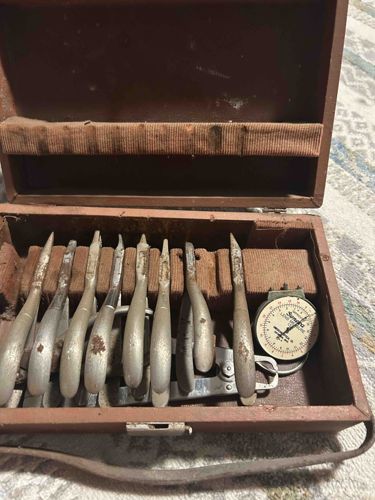
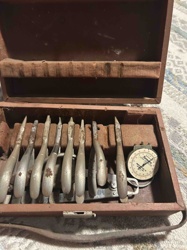
This appears to be an antique or vintage set of dental tools, likely used for tooth extraction or other oral surgery procedures, housed within its original wooden case. The case itself is a rectangular, chest-style box made of dark, possibly stained, wood, showing significant wear, scratching, and discoloration, indicating considerable age and use. The interior of the case is lined with a textured, possibly velvet or strong fabric material, which appears to be dark brown or reddish-brown, and is heavily deteriorated, frayed, and soiled, especially along the top flap and where the tools rest. The tools themselves are made predominantly of metal, likely steel, given their silver-grey appearance and the presence of significant rust and corrosion on their surfaces. Each tool features a distinct, ergonomic handle, likely designed for a firm grip during intricate dental work, which transitions into a specialized working end. Many of these working ends are thin and pointed or curved, suggesting their use for prying and extracting. There are approximately ten such tools visible, stored upright in individual slots within the case. One notable component within the case, located on the right side, is a circular dial gauge, possibly a pressure gauge or an anasthetic delivery device, labeled 'Suprema'. This gauge has a white face with black numerical markings and a needle, indicating it is a precision instrument. The overall condition suggests the set has seen extensive use and has not been meticulously preserved, leading to a heavy patina, extensive surface degradation, and general signs of age throughout both the tools and the case. The presence of 'Suprema' on the gauge could indicate the manufacturer or a brand. The style of the tools and the decay of the case suggest a late 19th to mid-20th century origin.
AI Appraisal Report
Upon examining the provided image of this Antique Dental Extraction Tool Set with Suprema Gauge, I assess its condition as poor to fair. The wooden case exhibits significant wear, scratching, discoloration, and what appears to be considerable deterioration of the internal fabric lining, suggesting extensive age and lack of meticulous preservation. The tools themselves, predominantly metal, display heavy rust, corrosion, and surface degradation, consistent with their purported age and usage. The 'Suprema' gauge's white face and needle appear intact, though its functionality cannot be verified through images alone.
Authenticity, based purely on visual inspection, appears consistent with a late 19th to mid-20th century origin, given the style of the tools and the overall distressed appearance of both the tools and the case. However, definitive authentication requires in-person examination to verify tool metallurgy, precise construction methods, and to check for manufacturer marks that are not visible in the image. Provenance documentation, such as original sales receipts or historical records of ownership, would significantly aid in full authentication and could impact value. Scientific testing, such as material analysis of the tools and case components, could further pinpoint manufacturing dates and origin.
Regarding market conditions, antique dental tools have collectors, primarily dental professionals, medical history enthusiasts, or those interested in macabre curiosities. Sets in significantly better condition with less corrosion and pristine cases generally fetch higher prices. The heavy degradation here limits its appeal to those looking for display-ready pieces. Rarity is difficult to ascertain from a single image; while generic extraction tools are not rare, a complete, branded set with a 'Suprema' gauge, if truly unique, could add value. However, the poor condition mitigates this.
Factors significantly impacting value include the extensive corrosion on the tools, the severely deteriorated case lining, and the general lack of preservation. While these elements speak to its age and history, they detract from its aesthetic and functional appeal. Comparables for heavily corroded sets, even complete ones, tend to be in the lower range of the antique tool market. Should the 'Suprema' gauge prove to be a particularly rare or historically significant component of a known manufacturer, this could slightly uplift the value, but its current visual condition also suggests wear.
My assessment is limited by the inability to physically inspect the tools, test the gauge's functionality, or examine hidden marks and areas of wear. Without in-person examination, I cannot comment on the tool's balance, the extent of surface pitting, or the integrity of any mechanical components within the gauge.