AI estimate as of September 20, 2025 · verify with a professional before acting
AI-Generated · Verify before acting
Everything on this page is generated by AI for informational purposes only. AI can make mistakes — the AI may misidentify items or misattribute them (artist, maker, brand, designer, origin, era). This is not an official valuation and should not be used for insurance, sale, tax, estate, legal, or lending purposes — or any decision requiring a certified appraisal. It is not an authoritative claim about any person, brand, or rights holder — do not share or rely on it as a factual statement about a third party. Always consult qualified professionals before making financial decisions.
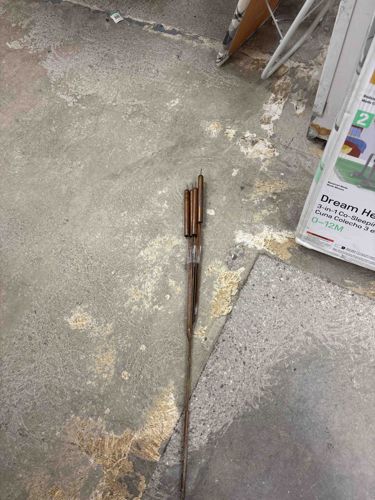
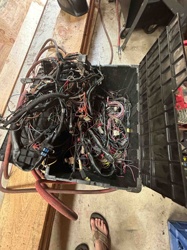
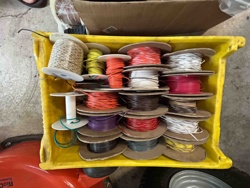
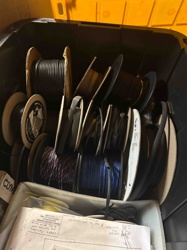
The item appears to be a bundle of several coaxial cables, likely made of copper or a copper alloy, given their reddish-brown metallic color. The cables are grouped together, with their ends visible at the top, suggesting they may have been cut or stripped. There are at least three, possibly more, individual cables bundled tightly at one end, transitioning into what looks like a single, elongated strand from the bundle. Each individual cable end shows a central conductor protruding slightly from the surrounding insulating material, which is consistent with the construction of coaxial cables. The cables exhibit a dull, oxidized patina, indicating age or exposure to the elements; their surface texture appears somewhat rough and discolored rather than shiny. The overall length of the bundled section is relatively short, while the full length of the visible combined cables extends considerably, lying flat on a concrete or similarly textured floor. There are no clear markings, manufacturing stamps, or logos visible in the provided image. Based on the material and apparent function, these are common industrial or domestic electrical components. The condition suggests they are either salvaged materials or surplus components, showing typical wear and tear expected from such items, including surface oxidation and possibly some fraying of the outer sheath in places, though this is not explicitly clear. The material composition and simple construction suggest a functional, rather than decorative, item, with no particular artistic or period style. These are modern electrical components.
AI Appraisal Report
I have examined the provided image of what appears to be a bundle of coaxial cables. Visually, the cables exhibit characteristics consistent with standard coaxial construction, featuring a central conductor and insulating material. The reddish-brown coloration suggests copper or a copper alloy. The ends show signs of being cut or stripped, and the overall dull, oxidized patina indicates age, exposure, or salvaged status. The surface appears rough and discolored, not a shiny, new finish.
Regarding condition, these appear to be used or discarded industrial/domestic components. While functional, their aesthetic appeal is nil. Authenticity is not a significant concern for such common electrical components; they are clearly coaxial cables. However, without physical examination, I cannot confirm the exact gauge, type of insulation, internal conductor material (e.g., solid copper vs. copper-clad steel), or the actual length of the usable material, which are crucial for precise valuation.
Market conditions for used coaxial cable are generally low. Comparables would include bulk scrap copper or used networking/AV cabling. Demand is primarily from scrap metal recyclers or hobbyists for very small projects. Rarity is not a factor; these are mass-produced items.
Factors significantly impacting value include the actual amount of copper content, the overall usable length, and the specific type/gauge, which can only be determined through physical inspection. As salvaged or surplus items, their value is inherently diminished. For full authentication and accurate valuation, I would need a physical inspection to measure length, assess conductor material, and confirm gauge. Testing for continuity or signal integrity would also be necessary if their intended use is beyond scrap. Without this, I am valuing them as general used coaxial cable, likely for scrap or very low-value reuse.