AI estimate as of August 7, 2025 · verify with a professional before acting
AI-Generated · Verify before acting
Everything on this page is generated by AI for informational purposes only. AI can make mistakes — the AI may misidentify items or misattribute them (artist, maker, brand, designer, origin, era). This is not an official valuation and should not be used for insurance, sale, tax, estate, legal, or lending purposes — or any decision requiring a certified appraisal. It is not an authoritative claim about any person, brand, or rights holder — do not share or rely on it as a factual statement about a third party. Always consult qualified professionals before making financial decisions.
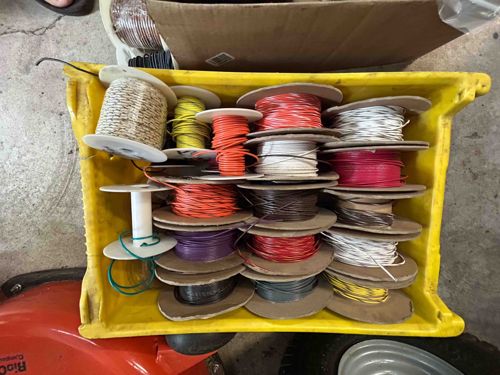
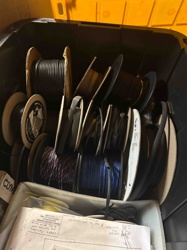
This item is a collection of various spools of electrical wire, housed within a bright yellow plastic bin or caddy. The bin appears to be a durable, injection-molded plastic with a textured, slightly worn surface, suggesting use in a workshop or industrial setting. Its dimensions appear to be approximately 1.5 to 2 feet in length and about 1 foot in width, based on the visible context of its surroundings, possibly resting on a red object that resembles a lawnmower or similar outdoor equipment. The spools themselves vary greatly in size and material, with some being white plastic and others made of cardboard. The wire on these spools comes in a wide array of colors, including red, orange, yellow, white, grey, brown, black, purple, and possibly others, indicating different gauges, types, or purposes of insulation. Many of the spools are stacked on top of one another, suggesting an organized storage method, although some wires show signs of being unspooled or tangled. The condition of the wires appears generally good, with no obvious signs of severe damage or corrosion on the insulation, though some spools show dust accumulation. The cardboard spools exhibit typical signs of wear and tear, such as slight bending or discoloration from age and handling. This collection likely comprises various gauges of hook-up wire or similar low-voltage electrical wiring, commonly used for electronics, automotive repair, hobbyist projects, or small appliance wiring. The overall presentation suggests a practical, utilitarian assortment of usable electrical supplies rather than a display piece. No specific manufacturer markings or branding are discernible on the spools or the wire itself, making it difficult to pinpoint a precise age or origin beyond general modern production.
AI Appraisal Report
I have examined the image provided for the Assorted Electrical Wire Spools in Plastic Bin. The item presents as a practical collection of various gauges and colors of electrical wire, housed within a textured yellow plastic bin. The bin itself shows signs of use, consistent with a workshop or industrial environment, and appears durable. The spools are a mix of plastic and cardboard, holding wires in numerous colors, indicating a range of applications such as electronics, automotive, or hobbyist projects. While some wires appear unspooled or tangled, the overall condition of the insulation seems good, with no obvious severe damage, though dust accumulation is visible. The cardboard spools show typical wear from handling and age.
From a market perspective, collections of miscellaneous electrical wire, while useful, generally command modest values. The lack of specific manufacturer markings or branding, as well as the ambiguous gauges, makes it challenging to ascertain the precise type or quality of wire beyond a visual assessment. Comparables in the hobbyist or DIY market often consist of bulk assortments, which are priced based on the quantity and assumed usability rather than rare or collectible status. Demand for such items is consistent among hobbyists, electricians, and DIY enthusiasts, but the supply is also high, reducing rarity considerations.
The primary factors impacting value are the unknown total length of usable wire, the specific gauges (which cannot be determined from the image alone), and the absence of any high-value specialized wires (e.g., high-temperature, shielded). Without knowing the exact type, length, and original quality, its value is primarily as a utilitarian assortment. Limitations in authenticity verification are significant; I cannot confirm the gauge, material purity (e.g., copper vs. aluminum), electrical conductivity, or precise length of each wire from images alone. A physical inspection would be crucial to determine the exact gauges, the actual amount of usable wire, and to perform continuity tests for full authentication and a more accurate valuation. Provenance documentation would be ideal to understand the history of the wire types. Based on what is visible, this is a functional assortment for general electrical purposes.