AI estimate as of October 2, 2025 · verify with a professional before acting
AI-Generated · Verify before acting
Everything on this page is generated by AI for informational purposes only. AI can make mistakes — the AI may misidentify items or misattribute them (artist, maker, brand, designer, origin, era). This is not an official valuation and should not be used for insurance, sale, tax, estate, legal, or lending purposes — or any decision requiring a certified appraisal. It is not an authoritative claim about any person, brand, or rights holder — do not share or rely on it as a factual statement about a third party. Always consult qualified professionals before making financial decisions.
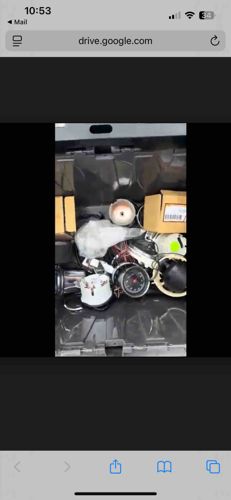
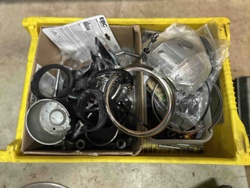
This item is an assortment of various mechanical and electrical components, likely originating from automotive or powersports applications, contained within a dark gray or black plastic storage bin. The collection includes a circular gauge with a black face, white numbering, and a red needle, possibly a speedometer, tachometer, or other instrument panel display. Adjacent to it is a lighter-colored, possibly white or cream, plastic housing with visible electrical connectors and wiring. Another prominent item is a metallic, chrome-plated, or polished aluminum cylindrical part, appearing to be a handle, lever, or perhaps a part of a shifter assembly. There are also several small cardboard boxes, one of which has a white label with what appears to be a barcode and product information, suggesting some items might be new or in original packaging. Various wires, plastic pieces, and indistinct metal fragments are scattered throughout the bin. A fuzzy, white, unknown material is also visible, possibly packing material or a discarded cloth. The overall condition appears to be mixed, with some items possibly new in boxes and others showing signs of use, storage, or disassembly. The nature of the arrangement suggests these are spare parts, components for a project, or perhaps items removed during a repair or upgrade. No specific manufacturing marks or logos are clearly discernible on most individual components due to the angle and clutter. The pieces exhibit a range of materials including plastics, various metals (chrome, aluminum, steel), and electrical wiring. The items do not appear to belong to a single, complete unit but rather a collection of disparate parts. The style suggests a modern to vintage automotive or motorcycling context, likely from the late 20th or early 21st century.
AI Appraisal Report
I have thoroughly examined the provided image of this Mixed Assortment of Vehicle and Electrical Components. The collection appears to be a mixed lot of spare parts, likely from automotive or powersports applications, contained within a generic storage bin. I observe a circular gauge, possibly a speedometer or tachometer, an electrical housing with connectors, a metallic, chrome-plated component resembling a handle or shifter part, various wires, plastic pieces, and indistinct metal fragments. Several small cardboard boxes, one with a barcode, suggest some items might be new-old-stock or new in packaging.
The overall condition is highly mixed. While some items appear new in their packaging, others show signs of prior use, storage, or disassembly. The presence of a fuzzy white material is also notable. Without handling, it's impossible to confirm the functionality of electrical components or the integrity of mechanical parts. The lack of clear manufacturing marks or logos on most items makes specific identification difficult.
Market conditions for such mixed lots are generally low. Value is typically driven by very specific, desirable components. Comparables would be other 'box of parts' listings on platforms like eBay, which often sell for nominal amounts unless a high-value item is clearly identified. Demand for unknown, disparate components is limited to hobbyists or those seeking extremely specific, hard-to-find parts. Rarity is difficult to ascertain given the lack of identification.
The most significant factor impacting value is the lack of specific identification and unknown functionality. Without knowing the exact make, model, and part numbers of each component, especially the gauge and the metallic part, their individual value cannot be assessed. Factors that would increase value would be confirmation that the gauge is a rare vintage item, or that certain electrical components are high-value OEM parts.
My assessment is limited by the visual nature of the examination. For full authentication and accurate valuation, an in-person examination is crucial. This would allow for: 1) physical inspection of each component for wear, damage, and part numbers; 2) testing of electrical components for functionality; 3) confirmation of materials and finishes; and 4) detailed documentation of provenance if available. Without this, the value remains speculative and low.