AI estimate as of October 5, 2025 · verify with a professional before acting
AI-Generated · Verify before acting
Everything on this page is generated by AI for informational purposes only. AI can make mistakes — the AI may misidentify items or misattribute them (artist, maker, brand, designer, origin, era). This is not an official valuation and should not be used for insurance, sale, tax, estate, legal, or lending purposes — or any decision requiring a certified appraisal. It is not an authoritative claim about any person, brand, or rights holder — do not share or rely on it as a factual statement about a third party. Always consult qualified professionals before making financial decisions.
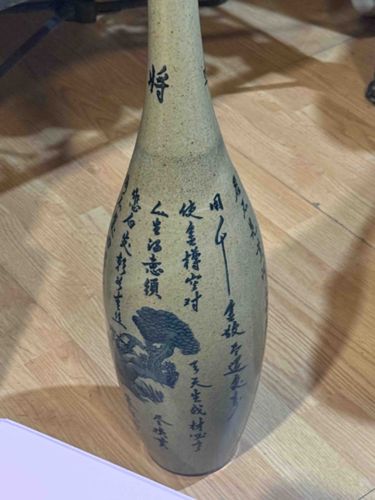
This item is a slender, tall ceramic vase with a light yellowish-beige, speckled matte finish. Its form transitions from a narrow, elongated neck to a wider, bulbous body that tapers gently towards the base. The surface of the vase is adorned with extensive black-ink calligraphy, likely in an East Asian script, covering much of its body. The characters exhibit varying strokes and sizes, suggesting a handwritten quality. Below a section of the calligraphy, there is a distinct, hand-painted motif of a pine tree or evergreen, rendered in dark blue or black. This botanical element is depicted with visible texture, indicating brushwork. The speckled texture of the ceramic itself gives the piece a rustic or earthy feel, possibly indicative of a specific type of clay or glazing technique, such as stoneware or a lightly glazed earthenware. There are no immediate visible signs of damage like chips or cracks, and the matte finish does not show significant signs of wear or scratches, suggesting an overall good condition. The craftsmanship appears to be artisanal, with the hand-painted calligraphy and motif adding to its unique charm. Without a discernible maker's mark or signature in the visible area, pinpointing the exact origin or age is challenging, but the style suggests an East Asian cultural context, potentially 20th century or earlier, though precise dating would require further expert analysis of the script and ceramic body.
AI Appraisal Report
Based on my visual examination of the provided image, this slender ceramic vase with calligraphy and a pine motif appears to be in very good overall condition. There are no readily apparent chips, cracks, or significant wear to the matte finish, which retains its speckled, light yellowish-beige appearance. The black-ink calligraphy and the dark blue/black hand-painted pine motif show good detail and brushwork, consistent with artisanal production. The form transitions smoothly from a narrow neck to a bulbous body, indicative of quality craftsmanship. Authenticity, based solely on this image, strongly suggests an East Asian origin, likely from the 20th century. The hand-painted elements contribute significantly to its unique aesthetic.
Market conditions for East Asian ceramics of this type are generally stable, with a strong demand for unique, handcrafted pieces. Comparables for similar ceramic vases with calligraphic or botanical motifs by unknown artisans typically fall within a broad range, influenced heavily by perceived age, artistic merit, and condition. The absence of a clear maker’s mark or signature prevents attribution to a known artist, which would significantly increase its value. Its rarity is moderate, as similar decorative vases are produced, but the specific combination of calligraphy and this particular pine motif makes it a one-of-a-kind piece.
Factors impacting value positively include its good condition, artisanal quality, and unique aesthetic. Valuation is limited without a physical inspection. For full authentication and more precise dating, an in-person examination would be crucial to assess the ceramic body, glaze composition, and any hidden marks. Microscopic analysis of the ceramic and pigments, along with expert translation and stylistic analysis of the calligraphy, would allow for a more definitive age and origin assessment. Provenance documentation, if available, would also be highly beneficial.