AI Appraisal Estimate

AI-generated estimates · not official valuations

From the user

What was submitted

Photo and notes provided by the user — not generated by AI

Submitted item photo
Submitted photo · June 6, 2026

User's notes

No additional notes provided.

AI analysis below

AI appraisal

AI analysis & estimate

AI-Generated · Verify before acting

Everything below is generated by AI for informational purposes only. AI can make mistakes — the AI may misidentify items or misattribute them (artist, maker, brand, designer, origin, era). This is not an official valuation and should not be used for insurance, sale, tax, estate, legal, or lending purposes — or any decision requiring a certified appraisal. It is not an authoritative claim about any person, brand, or rights holder — do not share or rely on it as a factual statement about a third party. Always consult qualified professionals before making financial decisions.

Read the full disclaimer

AI Identification

·Not independently authenticated·Verify before acting

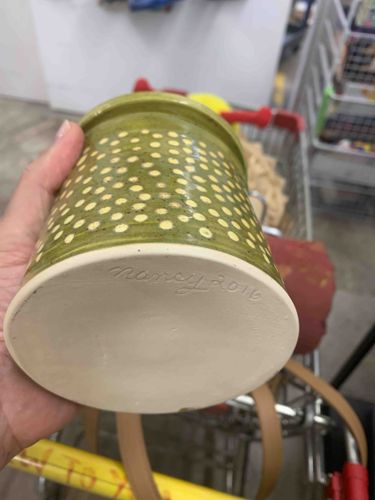
Handmade Polka Dot Ceramic Jar by Nancy (2016)

Pottery / Ceramic Container

AI Estimated Value

·Not an official valuation·Verify before acting

$40-60

As of June 6, 2026

AI Item Analysis

·AI can make mistakes·Verify before acting
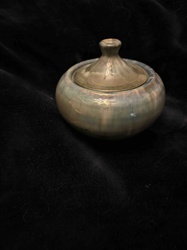
The item is a handmade ceramic container, likely a lidded jar or canister, with an earthy, olive-green glazed exterior featuring an irregular pattern of numerous off-white or light yellow polka dots. The dots are not uniform in size or placement, suggesting a hand-applied or organic method of decoration. The glaze appears somewhat textured or mottled, with visible variations in color depth, enhancing its artisanal appeal. The container has a sturdy, cylindrical form, slightly tapering inward towards the bottom. The interior and rim area are also glazed in the same green hue. The base of the container is unglazed, revealing the natural color of the clay body, which is a light beige or off-white. This unglazed bottom surface provides a clear surface for the maker's mark. Inscribed into the unfired clay on the bottom is the signature 'Nancy' in cursive script, followed by '2016', indicating the year of creation. The inscription is clear and well-defined, suggesting it was done before firing. The overall condition appears excellent, with no visible chips, cracks, or significant wear. The craftsmanship suggests a studio pottery piece, made by an individual artist or small workshop, rather than a mass-produced item. The visible marks within the glaze on the green body and the slightly imperfect dot application contribute to its unique, handcrafted character and indicate a deliberate artistic choice rather than a defect. The item exhibits good quality firing as evidenced by the clear inscription and robust form.
AI Appraisal Report

·AI can make mistakes·Verify before acting
Upon visual examination, this lidded ceramic jar by an artist named 'Nancy' is a fine example of contemporary studio pottery. The piece presents in excellent condition, with no observable chips, cracks, or crazing. The olive-green glaze with hand-applied polka dots gives it a unique, artisanal character. The signature 'Nancy' and the date '2016' are clearly incised on the unglazed base, which appears consistent with markings applied pre-firing. However, authentication based on images alone has inherent limitations. Without a known body of work for an artist named 'Nancy' from 2016, confirming the signature's authenticity is challenging. A physical inspection would be required to assess the weight, clay body, and glaze texture more thoroughly. Provenance, such as a bill of sale or gallery documentation, would be crucial for verification. The market for contemporary studio pottery by unlisted or lesser-known artists is modest. Value is primarily driven by decorative appeal, craftsmanship, and function rather than artist recognition. Comparable works from skilled but uncatalogued studio potters typically sell in the low-to-mid two-figure range. The primary value driver here is its aesthetic quality as a well-made decorative or functional object. Rarity is difficult to assess without knowing the artist's output, but it can be considered a unique, one-of-a-kind piece. A lack of established provenance or auction records for this specific artist significantly tempers its secondary market value.

Get your items appraised

Instant estimates of your treasures with AI-powered appraisals

Browse More Appraisals