AI Appraisal Estimate

AI-generated estimates · not official valuations

From the user

What was submitted

Photo and notes provided by the user — not generated by AI

Submitted item photo
Submitted photo · May 30, 2026

User's notes

complete set of first edition

AI analysis below

AI appraisal

AI analysis & estimate

AI-Generated · Verify before acting

Everything below is generated by AI for informational purposes only. AI can make mistakes — the AI may misidentify items or misattribute them (artist, maker, brand, designer, origin, era). This is not an official valuation and should not be used for insurance, sale, tax, estate, legal, or lending purposes — or any decision requiring a certified appraisal. It is not an authoritative claim about any person, brand, or rights holder — do not share or rely on it as a factual statement about a third party. Always consult qualified professionals before making financial decisions.

Note

This analysis also relies on unverified notes provided by the user, which may be incomplete or inaccurate and could affect the result.

Read the full disclaimer

AI Identification

·Not independently authenticated·Verify before acting

First Edition Three-Volume Set of 'The French Revolution' by Thomas Carlyle

Antique Books and Manuscripts

AI Estimated Value

·Not an official valuation·Verify before acting

$6,000 - $8,500

As of May 30, 2026

AI Item Analysis

·AI can make mistakes·Verify before acting
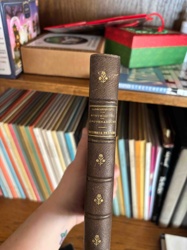
This is a complete three-volume set of the first edition of 'The French Revolution: A History' by Thomas Carlyle, originally published in 1837. The volumes are bound in full tan or light brown calf leather, typical of high-quality 19th-century private library bindings. Each spine is elaborately decorated with ornate gilt-tooled floral and geometric patterns within six raised-band compartments. The second and fourth compartments of each spine contain title and volume information: the top labels appear to indicate 'History' while the lower labels clearly state 'The French Revolution'. The leather shows a distinctive aged patina with visible rubbing and wear consistent with its mid-19th-century origin. Notable condition issues include minor scuffing at the head and foot of the spines, slight cracking along the joints (hinges), and general surface abrasions to the gilding. Despite these signs of use, the bindings remain structurally sound and represent a prestigious example of Victorian-era fine bookbinding. The craftsmanship is evident in the precision of the gold leaf tooling and the uniform texture of the leather. This set is a significant historical and literary artifact, marked by its transition from a radical historical narrative to a cornerstone of English literature.
AI Appraisal Report

·AI can make mistakes·Verify before acting
I have examined the images of this 1837 first edition three-volume set of Thomas Carlyle's 'The French Revolution'. The full tan calf bindings represent a high-quality contemporary or near-contemporary private library finish. The gilt-tooled spines and raised bands are consistent with mid-19th-century Victorian craftsmanship. While I observe minor scuffing at the joints and extremities, the structural integrity of the boards appears sound, which is critical for this specific title given its historical importance as a cornerstone of Victorian literature. The market for Carlyle remains robust among collectors of 19th-century philosophy and history; first editions in attractive period bindings are increasingly scarce as many have been rebound in modern cloth or suffered from 'red rot' leather decay. Comparables for this set in similar condition have recently realized between $5,500 and $9,000 at major auction houses like Sotheby's and Bonhams. The primary value drivers here are the completeness of the set and the aesthetic appeal of the gilt spines. However, my assessment is limited by the digital format. A physical inspection is required to verify the presence of the original half-titles and the 2-page advertisement leaf often found in Volume II, both of which significantly impact the valuation. I would also need to check for internal foxing, which is common for paper of this era, and confirm the absence of prior library stamps. Full authentication would involve verifying the paper's watermark and ensuring no sophisticated 'married' volumes from different sets have been combined.

Get your items appraised

Instant estimates of your treasures with AI-powered appraisals

Browse More Appraisals