AI identification & appraisal estimate

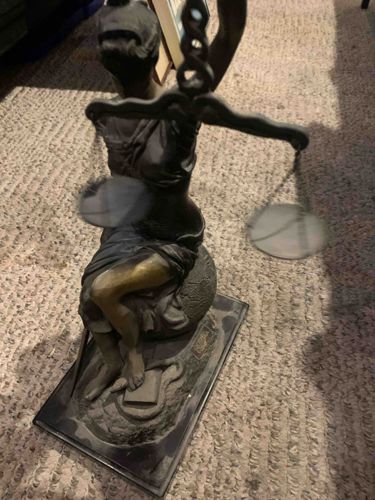
Lady Justice Statue

This name is the AI's identification of the item — it may be incorrect.

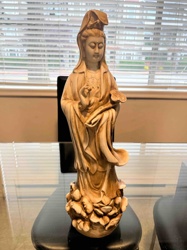
Submitted photo of Lady Justice Statue
Photo submitted by the user — not generated by AI

AI Estimated Value

Not an official valuation

$400-800

AI estimate as of June 24, 2025 · verify with a professional before acting

AI-Generated · Verify before acting

Everything on this page is generated by AI for informational purposes only. AI can make mistakes — the AI may misidentify items or misattribute them (artist, maker, brand, designer, origin, era). This is not an official valuation and should not be used for insurance, sale, tax, estate, legal, or lending purposes — or any decision requiring a certified appraisal. It is not an authoritative claim about any person, brand, or rights holder — do not share or rely on it as a factual statement about a third party. Always consult qualified professionals before making financial decisions.

Read the full disclaimer

AI Item Analysis

The item is a statue of Lady Justice, a allegorical personification of the moral force in judicial systems. The statue depicts Lady Justice seated upon a globe, which may symbolize her global reach or the world over which justice presides. Her right arm is raised, holding what appears to be a broken or incomplete set of scales, traditionally used to weigh evidence for and against. Her left arm is not fully visible but she appears to be blindfolded, a common attribute symbolizing impartiality. The statue exhibits a dark, possibly bronze or bronze-finished material, indicated by the dark overall color and hints of metallic sheen, particularly on her draped clothing and lower leg where a lighter, aged bronze tone is visible. The base is rectangular and features a relief depiction of a serpent being crushed under her feet, with a book, likely law books, also underneath. The overall construction appears solid and well-made, suggesting it might be cast metal or a resin composite with a metallic finish. The surface exhibits a significant layer of dust and grime, particularly on the base and in crevices, indicating it has been neglected or stored without proper cleaning for some time. There are no immediate visible signs of damage such as cracks or chips, but the scales being incomplete could be an intentional artistic choice or a breakage. The style suggests a classical or neoclassical influence, with a probable manufacturing period spanning from the late 19th century to mid-20th century, or even a contemporary reproduction in an antique style. The craftsmanship points to a decorative or symbolic piece intended for display in a professional setting like a law office or home study. The quality seems good, evident in the detailed sculpting of the figure and the base elements.

AI Appraisal Report

I have examined the image of this Lady Justice statue and can offer an appraisal based on visual observation. This statue appears to be a well-crafted piece, likely bronze or a bronze-finished composite, dating from the late 19th to mid-20th century, or a later reproduction in an antique style. The depiction of Lady Justice seated on a globe, with a serpent being crushed underfoot and law books on the base, is symbolic and well-executed.The primary observation regarding condition is the significant layer of dust and grime, suggesting neglect. This is superficial and easily remediable with proper cleaning, which would enhance its visual appeal and perceived value. The most notable aspect is the incomplete scales in her right hand; it is unclear from the image if this is intentional artistic representation or breakage. An in-person examination would be crucial to determine this.The market for classical allegorical statues remains consistent, particularly for legal professionals or collectors. Pieces of this quality and size generally see stable demand. Rarity is moderate; while Lady Justice statues are common, detailed pieces like this, especially if bronze, are less so.Factors impacting value include material (bronze vs. composite), age, and the condition of the scales. If bronze and antique, its value greatly increases. If a composite, its value is more decorative.Without a physical examination, I cannot definitively determine the material composition (e.g., solid bronze vs. bronze-clad resin), the true age, or whether the scales are broken or designed that way. Provenance documentation could significantly enhance authenticity and value. Scientific testing (e.g., material analysis) would be needed for absolute verification.

Keep exploring

More statue appraisals

Get your items appraised

Instant AI-powered appraisal estimates from a photo

Browse More Appraisals