AI estimate as of June 27, 2025 · verify with a professional before acting
AI-Generated · Verify before acting
Everything on this page is generated by AI for informational purposes only. AI can make mistakes — the AI may misidentify items or misattribute them (artist, maker, brand, designer, origin, era). This is not an official valuation and should not be used for insurance, sale, tax, estate, legal, or lending purposes — or any decision requiring a certified appraisal. It is not an authoritative claim about any person, brand, or rights holder — do not share or rely on it as a factual statement about a third party. Always consult qualified professionals before making financial decisions.
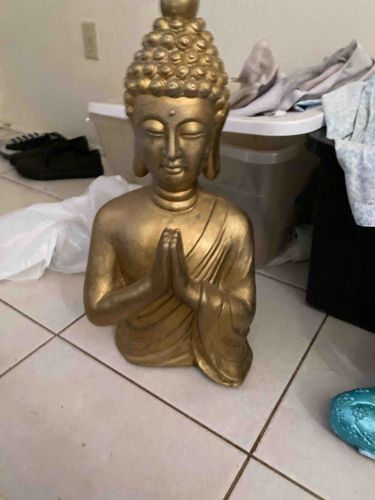
This is a tabletop or floor statue depicting the bust of Buddha, likely intended for decorative purposes. It appears to be made from a lightweight material such as resin, molded plastic, or possibly fiberglass, given its smooth finish and the lack of visible seams or casting marks that would suggest metal or stone. The statue is painted with a metallic gold finish, which simulates the appearance of aged bronze or brass, featuring some subtle variations in tone that could be intentional to add depth or a result of light wear. The Buddha is depicted with closed eyes, a serene expression, elongated earlobes, and the traditional Ushnisha (a protuberance on the head symbolizing wisdom) composed of tightly curled hair or bumps. The hands are positioned in the 'Anjali Mudra' or 'Namaste' gesture, pressed together at the chest. The drapery of the robes is visible over the left shoulder and across the torso, rendered with simple, flowing lines. The height is significant, likely ranging from 18 to 24 inches based on its apparent scale against the floor tiles, making it a substantial decorative piece. There are no clearly discernible maker's marks or signatures visible in the provided image. The overall condition appears good, with no major chips or cracks visible, although some scuffing or minor paint loss might be present upon closer inspection, fitting with its likely modern manufacturing and decorative intent. It embodies a contemporary interpretation of traditional Buddhist iconography, suitable for a spiritual or meditative home environment. The craftsmanship is decent for a mass-produced item, with attention given to the characteristic features of Buddha imagery.
AI Appraisal Report
Upon examining the provided image of this Gold Finish Buddha Bust Statue, my assessment of its condition is good. I observe no obvious chips, cracks, or significant wear from the visual information available. The gold finish appears consistent across the surface with some intentional variations to simulate age or texture. Authenticity, in terms of its material and origin, is limited without physical inspection. Based on the uniform finish and lack of visible seams, I strongly suspect this is a mass-produced item made from resin, molded plastic, or fiberglass, rather than a solid metal casting or hand-carved stone. The 'Anjali Mudra' and 'Ushnisha' are correctly depicted, aligning with common Buddhist iconography.
Market conditions for religious/spiritual decor, particularly Buddha statues, are generally stable. Similar gold-finished resin or composite statues of this size (estimated 18-24 inches) are widely available from various online retailers and home decor stores. Comparables typically retail in the range of $50-$150. There is no indication of rarity; this appears to be a contemporary, decorative piece. Factors impacting value are primarily its decorative appeal and condition. Its material (likely resin/plastic) significantly limits its intrinsic value compared to bronze, stone, or antique pieces. Without a visible maker's mark or provenance documents, it is assessed purely as a modern decorative object.
To fully verify authenticity regarding its material composition, date of manufacture, and potential artist/manufacturer, an in-person examination, including weighing the item, assessing its texture, and potentially conducting material analysis, would be necessary. Any accompanying documentation, such as purchase receipts or certificates of authenticity, would also be crucial.