AI estimate as of October 28, 2025 · verify with a professional before acting
AI-Generated · Verify before acting
Everything on this page is generated by AI for informational purposes only. AI can make mistakes — the AI may misidentify items or misattribute them (artist, maker, brand, designer, origin, era). This is not an official valuation and should not be used for insurance, sale, tax, estate, legal, or lending purposes — or any decision requiring a certified appraisal. It is not an authoritative claim about any person, brand, or rights holder — do not share or rely on it as a factual statement about a third party. Always consult qualified professionals before making financial decisions.
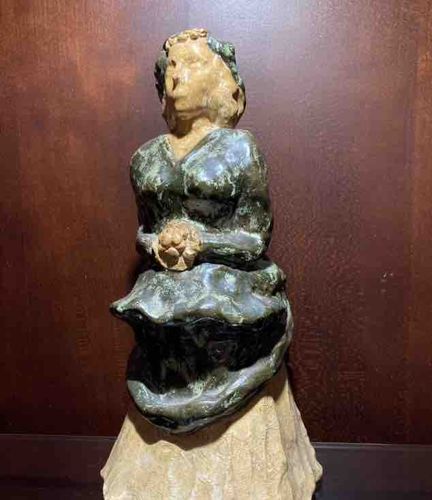
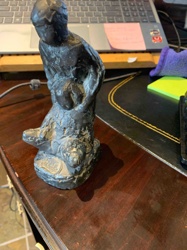
This appears to be a figural statue depicting the upper torso of a woman, possibly crafted from a ceramic or terracotta material, and potentially with some elements of paper mache or similar composite medium given its somewhat irregular and organic texture. The figure is rendered in a somewhat folk art or outsider art style, characterized by its less refined details and expressive quality. The woman's face is light tan or beige, with undefined features, suggesting a focus on the overall form rather than precise realism. Her hair, which appears to be pulled back, is depicted in a darker, greenish-brown tone. She is wearing a garment that has a V-neckline and appears to have short sleeves, colored in a mottled dark green and black, showing intentional texturing or an aged patinated finish, possibly imitating bronze or aged copper. Her hands are clasped together at waist level, holding what appears to be a small, light brown, stylized floral or spherical object. The lower part of the figure, from the waist down, is a contrasting light beige or cream color, with visible folds creating the impression of a skirt or draped fabric. The overall construction suggests a handmade origin. The visible texture throughout, particularly on the 'clothing' and 'skirt' areas, indicates a certain degree of craftsmanship but not a highly polished or industrialized finish. The dark green and black portions show variability in color saturation, suggesting either applied patinas or uneven glazing. There are no discernible maker's marks or signatures visible in the provided images. The condition appears to be relatively good with no obvious chips or cracks, but the intentionally rough finish might obscure minor imperfections. The style points to a mid-20th century or later creation, possibly a studio art piece rather than a mass-produced item. The distinct color blocking and textural contrast add to its unique character.
AI Appraisal Report
Upon examining the image of this figural statue, I assess its condition as good, with no obvious chips, cracks, or significant damage visible. The intentionally rough and textural finish, characteristic of a folk art or studio pottery style, makes minor surface imperfections difficult to discern without physical inspection. Authenticity-wise, based on visual cues, this piece appears to be a legitimate, handcrafted work, likely from the mid to late 20th century. The unique color blocking, organic forms, and expressive quality strongly suggest a studio art piece rather than a mass-produced item.
Market conditions for such figural ceramic or mixed-media folk art are steady but generally not in high demand for exceptionally high prices unless attributed to a well-known artist. Comparable items by unlisted or lesser-known studio artists often retail in the $100-$300 range, depending on size, artistic merit, and origin. This piece's distinctive style and handmade character contribute positively to its value. However, without a signature or maker's mark, it falls into the broader category of decorative arts. Rarity is difficult to ascertain without knowing the creator or production numbers, but it likely represents a singular or limited production.
Factors significantly impacting value include the lack of artist attribution, which prevents it from reaching higher values associated with named artists. To definitively verify authenticity and potentially attribute the piece, an in-person examination would be crucial to assess the material composition more accurately (e.g., distinguishing between ceramic, terracotta, or composite mixtures). Tracing its provenance, such as previous ownership or acquisition details, would also be invaluable. Scientific testing of materials could potentially assist in dating, but it's often cost-prohibitive for pieces in this price range.