AI Appraisal Estimate

AI-generated estimates · not official valuations

From the user

What was submitted

Photo and notes provided by the user — not generated by AI

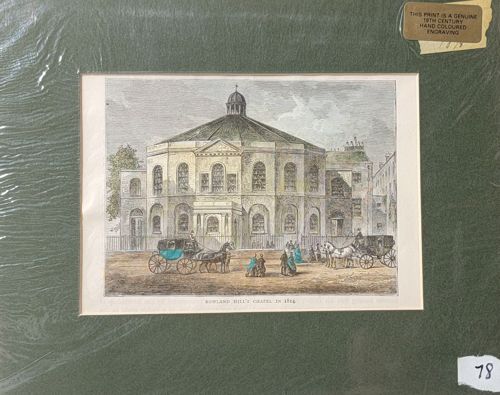
Submitted item photo
Submitted photo · June 13, 2026

User's notes

No additional notes provided.

AI analysis below

AI appraisal

AI analysis & estimate

AI-Generated · Verify before acting

Everything below is generated by AI for informational purposes only. AI can make mistakes — the AI may misidentify items or misattribute them (artist, maker, brand, designer, origin, era). This is not an official valuation and should not be used for insurance, sale, tax, estate, legal, or lending purposes — or any decision requiring a certified appraisal. It is not an authoritative claim about any person, brand, or rights holder — do not share or rely on it as a factual statement about a third party. Always consult qualified professionals before making financial decisions.

Read the full disclaimer

AI Identification

·Not independently authenticated·Verify before acting

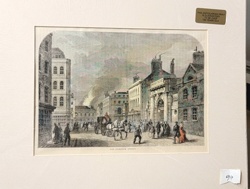
Rowland Hill's Chapel in 1814 Hand-Coloured Engraving

Antique Prints and Artworks

AI Estimated Value

·Not an official valuation·Verify before acting

$150-250

As of June 13, 2026

AI Item Analysis

·AI can make mistakes·Verify before acting
This item is a nineteenth-century hand-coloured engraving titled 'Rowland Hill’s Chapel in 1814.' The architectural landscape depicts the famous Surrey Chapel in London, characterized by its distinctive octagonal shape and central cupola. The scene is populated with detailed historical elements, including horse-drawn carriages, figures in Regency-era dress, and meticulously rendered windows and architectural stonework. The print features a soft, hand-tinted palette of muted earth tones, pale blues, and greens, which brings a subtle vibrancy to the architectural line work. A gold sticker in the upper right corner of the matting certifies it as a 'Genuine 19th Century Hand Coloured Engraving,' and a handwritten '1814' is visible below it. The piece is mounted within a textured, dark forest-green pass-partout mat and is currently protected by clear plastic film wrap. There is an auction or inventory tag labeled '78' pinned to the bottom right corner. The engraving shows minor foxing or light oxidation consistent with its estimated age. The printing reveals fine hatching and stippling techniques characteristic of high-quality period engravings, suggesting skilled craftsmanship by the original artist and engraver.
AI Appraisal Report

·AI can make mistakes·Verify before acting
I have conducted a visual examination of the hand-coloured engraving ‘Rowland Hill’s Chapel in 1814.’ The work depicts the Surrey Chapel, a significant site in London’s religious and social history. The engraving exhibits fine stippling and line work characteristic of early 19th-century plate production. The hand-tinting is delicate and follows the architectural lines well, indicating a high level of period craftsmanship. I observe minor foxing and slight oxidation across the paper, which is consistent with an antique age of roughly 200 years. The certification sticker and inventory tag provide a baseline for provenance, though they are secondary to the paper's physical characteristics. The market for topographical London engravings remains steady among historical collectors, though values have softened from their peak in the late 20th century. Comparables for framed architectural prints of similar size and subject matter typically fall within the $150 to $300 range at boutique auctions or specialized antique shops. The rarity is moderate; while many such plates were produced for historical volumes, surviving hand-coloured examples in good condition are desirable. Limitations: My assessment is based solely on high-resolution imagery. A definitive valuation would require an in-person inspection to remove the item from its plastic wrap and matting to inspect the paper’s watermark, the presence of a plate mark (Platemark), and to ensure the ‘hand-colouring’ isn't a modern lithographic reproduction. Scientific testing of ink acidity and paper fibers, along with a documented chain of ownership (provenance), would be necessary to verify this as a true first-state striking rather than a later Victorian-era restrike from the original plate.

Get your items appraised

Instant estimates of your treasures with AI-powered appraisals

Browse More Appraisals