AI estimate as of July 30, 2025 · verify with a professional before acting
AI-Generated · Verify before acting
Everything on this page is generated by AI for informational purposes only. AI can make mistakes — the AI may misidentify items or misattribute them (artist, maker, brand, designer, origin, era). This is not an official valuation and should not be used for insurance, sale, tax, estate, legal, or lending purposes — or any decision requiring a certified appraisal. It is not an authoritative claim about any person, brand, or rights holder — do not share or rely on it as a factual statement about a third party. Always consult qualified professionals before making financial decisions.
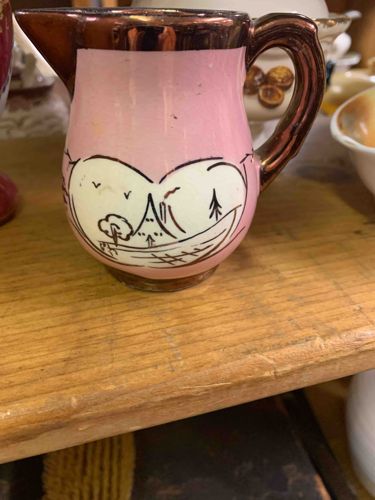
This item is a small, decorative ceramic pitcher, likely a creamer or a miniature jug. Its primary color is a soft, rosy pink applied over a lighter base, possibly white or cream ceramic, which is visible in the lower decorative band. The top rim, interior of the spout, and the entire handle feature a metallic, coppery-bronze luster glaze, providing a striking contrast to the matte or semi-gloss pink body. The pitcher has a classic form with a wide mouth, a small pouring spout, and an intricately shaped C-scroll handle designed for gripping. A notable decorative feature is a heart-shaped motif on the front, rendered in white with black outlines, depicting a stylized landscape scene. This scene includes a small building or tent, possibly a conical teepee-like structure, nestled among trees or shrubbery, with small birds flying overhead. The base appears to be a natural or darker ceramic color, providing a solid foundation. The pink surface exhibits fine crackling or crazing, a common characteristic in older glazed ceramics, indicating age and the firing process. There are also several small dark specks or surface imperfections on the pink glaze, some appearing as small surface abrasions or trapped debris during manufacturing. The luster glaze on the rim and handle shows some wear consistent with age and handling, appearing slightly dulled in areas. The craftsmanship suggests it was mass-produced but with hand-applied decorative elements. Given the style, materials, and visible crazing, it could date from the mid-20th century, possibly 1940s-1970s, reflecting a kitschy or whimsical aesthetic popular during those periods.
AI Appraisal Report
Upon visual examination of the images, this decorative ceramic pitcher presents itself as a charming, likely mid-20th-century piece. The combination of the pink body, copper luster glaze, and the whimsical, hand-decorated heart-shaped landscape motif is characteristic of mass-produced decorative wares from the 1940s to 1970s. The crazing visible across the pink glaze is consistent with its age and is an expected characteristic, not necessarily a flaw. There is minor wear on the luster glaze of the handle and rim, and some surface imperfections, which are typical for an item of this vintage and type.
From a market perspective, this pitcher falls into the category of collectible decorative ceramics, often referred to as 'kitsch.' While there is a steady market for such items, they are not considered rare. Numerous similar lusterware pitchers were produced in the United States, Japan, and parts of Europe during this period. Demand is driven primarily by collectors of specific manufacturers or those seeking nostalgic or decorative pieces. The value is significantly influenced by its decorative appeal rather than any inherent rarity or precious materials.
Without a maker's mark visible on the base, attributing it to a specific, highly sought-after manufacturer like McCoy or specific Staffordshire potteries is impossible. This lack of attribution is the primary factor limiting its value. Full authentication would require an in-person examination to inspect for maker's marks, analyze the clay body, and assess the true extent of wear. Without this, I cannot definitively confirm its origin or rule out it being a more recent reproduction, though its characteristics strongly suggest a vintage piece.