AI estimate as of October 2, 2025 · verify with a professional before acting
AI-Generated · Verify before acting
Everything on this page is generated by AI for informational purposes only. AI can make mistakes — the AI may misidentify items or misattribute them (artist, maker, brand, designer, origin, era). This is not an official valuation and should not be used for insurance, sale, tax, estate, legal, or lending purposes — or any decision requiring a certified appraisal. It is not an authoritative claim about any person, brand, or rights holder — do not share or rely on it as a factual statement about a third party. Always consult qualified professionals before making financial decisions.
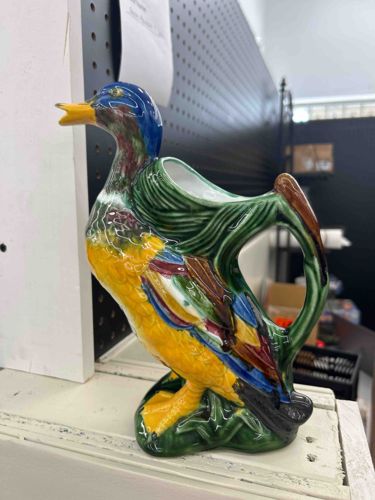
This is a vibrantly colored ceramic pitcher designed in the form of a mallard duck, characteristic of a majolica-style piece. The item is crafted from glazed ceramic, featuring a detailed, three-dimensional representation of a duck. Its color palette is rich and diverse, with a prominent royal blue head, a green neck with textured feathering, a vivid yellow body, and variegated wings displaying shades of blue, burgundy, brown, and green. The duck's feet and the base it stands on are rendered in a dark green, mimicking foliage or water. The beak is a bright, contrasting yellow. The pitcher's opening is subtly integrated into the duck's back, between the neck and the tail, and the handle gracefully extends from the back of the neck to the tail section, also decorated with green textured elements. The surface shows a high-gloss glaze throughout, enhancing the bright colors. There do not appear to be any significant visible condition issues such as chips, cracks, or repairs from the provided image, suggesting good preservation. The craftsmanship indicates a decorative rather than purely utilitarian purpose, though it is fully functional as a pitcher. The detailed molding and hand-painted appearance suggest a mid-20th century to contemporary production, possibly inspired by antique majolica ware, which is known for its brightly colored, often sculptural pottery. No specific maker's marks or signatures are visible in the provided images, but the overall quality of the glazing and painting suggests a well-made decorative item.
AI Appraisal Report
Based on my visual examination of the provided image, this Majolica Style Ceramic Mallard Duck Pitcher appears to be in excellent condition. I observe no obvious chips, cracks, or repairs, and the high-gloss glaze is well-preserved, enhancing its vibrant colors. The detailed molding and hand-painted aesthetic are consistent with decorative majolica-style ceramics. While beautifully crafted, this piece likely falls into the category of decorative rather than antique majolica. Its detailed execution suggests a mid-20th century to contemporary production, inspired by earlier styles rather than being an original 19th-century or earlier majolica piece. True antique majolica, particularly from renowned makers, commands significantly higher prices.
Market conditions for decorative ceramic pitchers of this style are stable but not rapidly appreciating. Comparable items, often referred to as 'majolica-style' or 'novelty figural pitchers,' typically sell in the range of $50 to $150, depending on the maker, specific detail, and condition. This particular piece's vibrant color palette and seemingly flawless condition contribute positively to its appeal.
Demand for such decorative items tends to be driven by collectors of novelty ceramics or those seeking accent pieces for country or eclectic decor. While it's not exceedingly rare, its good condition and attractive design make it a desirable example within its category. The lack of visible maker's marks is a significant factor in limiting its top-tier value, as an identified manufacturer could potentially increase its collectibility. Full authentication, beyond what is visible in images, would require a physical inspection to check for maker's marks, assess the ceramic body, and potentially perform scientific dating if an older origin were suspected. Without physical examination, I cannot definitively rule out minor unseen damage or confirm the exact period of manufacture.