AI estimate as of October 23, 2025 · verify with a professional before acting
AI-Generated · Verify before acting
Everything on this page is generated by AI for informational purposes only. AI can make mistakes — the AI may misidentify items or misattribute them (artist, maker, brand, designer, origin, era). This is not an official valuation and should not be used for insurance, sale, tax, estate, legal, or lending purposes — or any decision requiring a certified appraisal. It is not an authoritative claim about any person, brand, or rights holder — do not share or rely on it as a factual statement about a third party. Always consult qualified professionals before making financial decisions.
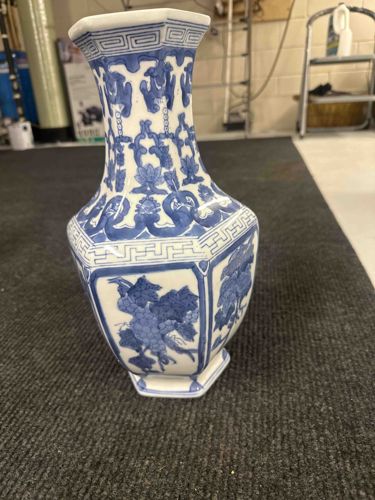
This is an octagonal porcelain vase adorned with intricate blue and white underglaze decoration. The vase features a flared, octagonal rim at the top, a tapering neck, a bulbous body, and a conforming octagonal foot. The primary color palette consists of a bright white porcelain ground with cobalt blue detailing. The neck of the vase is decorated with a geometric key-fret border along the rim, below which are recurring floral or stylized lotus patterns interspersed with what appear to be auspicious symbols or mythical creatures. The main body of the vase is divided into eight panels, each showcasing a different hand-painted design. On the visible panels, robust clusters of grapes with large leaves are depicted, suggesting a harvest or abundance motif. The craftsmanship appears to be of good quality, with consistent application of the blue pigment, though some slight variations in tone are natural for underglaze painting. No obvious cracks, chips, or repairs are immediately visible from the provided images, suggesting a relatively good condition. The glaze has a subtle sheen. The style indicates a likely East Asian (possibly Chinese) origin, potentially dating from the mid-20th century or earlier, though without specific maker's marks or clearer provenance, a precise age is difficult to determine. The combination of geometric patterns and naturalistic floral and fruit elements is a common characteristic of traditional blue and white porcelain.
AI Appraisal Report
I have examined the provided image of this Blue and White Octagonal Porcelain Vase with Grape and Floral Motifs. Visually, the vase appears to be in relatively good condition, with no immediate indications of major chips, cracks, or repairs, and the glaze maintains a subtle sheen. The execution of the underglaze cobalt blue decoration is consistent, showing the expected variations in tone typical of hand-painted ceramics. The design elements, including the key-fret border, floral scrolls, and particularly the grape motifs within octagonal panels, are consistent with East Asian, likely Chinese, blue and white porcelain traditions.
Authenticity from images alone is challenging. While the style strongly suggests a traditional Chinese origin, possibly mid-20th century or earlier, precise dating and origin without physical inspection or provenance are speculative. The market for decorative blue and white porcelain is broad, with pieces from the mid-20th century commanding moderate prices unless attributed to a specific kiln or artist. Reproductions are common, but the quality of this piece hints at a better-tier decorative item. Demand for attractive, well-presented blue and white ware remains steady, particularly for items with appealing motifs like these grapes. Rarity is difficult to ascertain; while unique, similar decorative vases are not inherently rare.
Factors significantly impacting value include its decorative appeal, apparent good condition, and potential age. A precise identification of the dynasty or specific period, if older than mid-20th century, would drastically increase its value.
For full authentication and a more precise valuation, an in-person examination is crucial to assess the true condition, examine the foot rim for firing imperfections or maker's marks, feel the glaze quality, and potentially conduct scientific testing to determine porcelain composition and age. Provenance documentation, if available, would also be invaluable.