AI estimate as of August 5, 2025 · verify with a professional before acting
AI-Generated · Verify before acting
Everything on this page is generated by AI for informational purposes only. AI can make mistakes — the AI may misidentify items or misattribute them (artist, maker, brand, designer, origin, era). This is not an official valuation and should not be used for insurance, sale, tax, estate, legal, or lending purposes — or any decision requiring a certified appraisal. It is not an authoritative claim about any person, brand, or rights holder — do not share or rely on it as a factual statement about a third party. Always consult qualified professionals before making financial decisions.
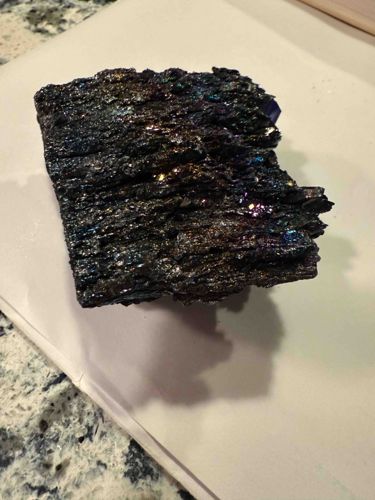
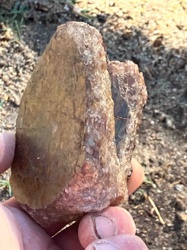
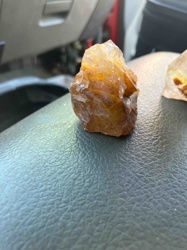
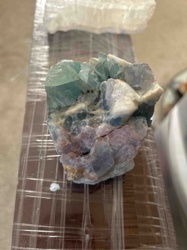
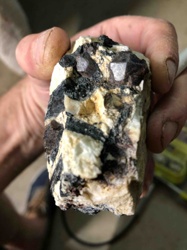
The item is a raw, jagged specimen of what appears to be iridescent Carborundum (Silicon Carbide, SiC). Its physical characteristics include a predominantly dark, almost black base color, heavily interspersed with brilliant, sparkling iridescent flakes that reflect light in a spectrum of colors including blues, purples, greens, yellows, and oranges. The surface is highly textured and rough, indicating a crystalline structure that has formed in layers or aggregates, giving it a somewhat flaky or lamellar appearance in places. The overall shape is irregular, characteristic of a naturally occurring or synthetically grown crystal cluster that has not been polished or cut. Size cannot be definitively determined without a scale, but it appears to be a hand-sized specimen. There are numerous sharp edges and points throughout the piece. No discernible manufacturing marks or signatures are visible. The iridescent effect is a notable feature, often referred to as 'peacock ore' due to its vibrant color play. Its condition appears to be stable, with the inherent ruggedness being part of its natural or synthetic formation rather than damage. There are no obvious signs of wear, repairs, or significant breakage beyond the natural cleavages and fractures of its formation. This material is known for its extreme hardness and abrasive properties. Given its appearance, it is likely a modern synthetic crystal, commonly produced for industrial applications but also valued as a mineral specimen for its aesthetic appeal. The craftsmanship is inherent in the crystal growth process, presenting a naturalistic and intricate structure.
AI Appraisal Report
Based on my visual examination of the provided image, this iridescent Carborundum (Silicon Carbide) specimen exhibits characteristic features of a synthetic crystal. The striking iridescence, displaying a spectrum of colors, is typical for industrially produced SiC, often referred to as 'peacock ore' in the mineral hobbyist market. Its rough, jagged, and aggregated crystalline structure is consistent with the growth patterns of carborundum. The condition appears excellent, with no signs of damage beyond its inherent natural or synthetic formation. Carborundum's extreme hardness ensures durability, and the vibrant iridescence is well-preserved.
Authenticity: While its appearance is highly indicative of synthetic Carborundum, a definitive determination of its origin (natural vs. synthetic, although natural occurrences are exceedingly rare for such aesthetic specimens) cannot be made from images alone. Further scientific testing, such as X-ray diffraction or spectroscopy, would confirm its composition and crystal structure. Provenance documentation, if available, could shed light on its manufacturing origin and history. Given its common availability as a byproduct or intentionally grown specimen, I am confident in its identity as Silicon Carbide.
Market Conditions & Demand: The market for iridescent Carborundum specimens is driven primarily by collectors and enthusiasts who appreciate its unique aesthetic appeal. It is not considered a rare mineral in the synthetic sense, as it is widely produced for abrasive and semiconductor industries. However, specimens with particularly vibrant iridescence and desirable sculptural forms command higher prices. Comparables in the retail market for mineral specimens of similar size and quality typically range from $20 to $100, depending on the intensity of iridescence, size, and overall sculptural appeal.
Value Factors: The primary drivers of value for this piece are its intense, multi-colored iridescence and its appealing, intricate crystalline formation. Its apparent stable condition also contributes positively. The lack of rarity from a geological standpoint, due to its synthetic origin, limits its upper value considerably. The absence of specific size information also constrains a more precise valuation.
In-person examination would allow for physical assessment of size, weight, and a more thorough appreciation of the 3D structure and iridescence under varying light conditions, which could slightly refine the value.