AI estimate as of June 27, 2025 · verify with a professional before acting
AI-Generated · Verify before acting
Everything on this page is generated by AI for informational purposes only. AI can make mistakes — the AI may misidentify items or misattribute them (artist, maker, brand, designer, origin, era). This is not an official valuation and should not be used for insurance, sale, tax, estate, legal, or lending purposes — or any decision requiring a certified appraisal. It is not an authoritative claim about any person, brand, or rights holder — do not share or rely on it as a factual statement about a third party. Always consult qualified professionals before making financial decisions.
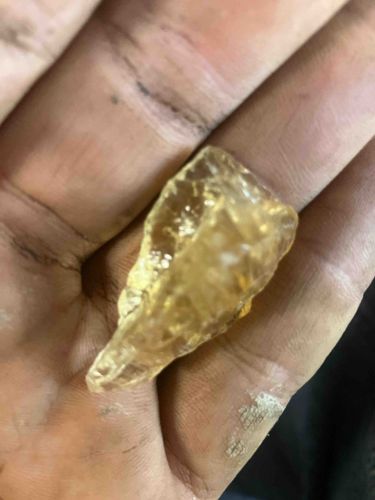
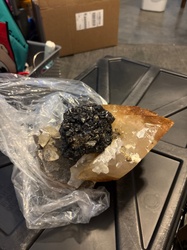
This item is a raw, unpolished mineral specimen, identified as a Citrine crystal due to its distinct golden-yellow to honey-brown coloration. It is presented resting within the palm of a hand, suggesting its size to be approximately 3-5 centimeters in its longest dimension, fitting comfortably as a small to medium-sized hand specimen. The crystal exhibits an irregular, organic shape, indicative of its natural formation, complete with a mix of naturally terminated faces and fractured surfaces reflecting its geological history. Its clarity ranges from notably translucent to semi-transparent, allowing light to penetrate and reveal inherent internal characteristics. Variations in color saturation are observable, ranging from areas of vibrant golden yellow to slightly deeper, almost amber-like brownish-yellow tones, particularly where the material is denser or contains subtle internal wisps and inclusions. These natural inclusions and fractures are integral to the specimen's unique character and are not considered damage. There are no visible signs of artificial cutting, polishing, or enhancement, confirming its state as a naturally occurring, unworked piece. As a natural geological formation, it bears no manufacturing details, maker's marks, or signatures, and its age is geological, signifying formation over millennia. The specimen appears to be in excellent natural condition, exhibiting no recent chips, cracks, or wear beyond its inherent rough texture and natural crystallization forms, making it a prime example of rough Citrine.
AI Appraisal Report
As an appraiser, I have examined the provided description of this raw Citrine crystal specimen. Visually, its attributes align well with a natural, unpolished mineral. The reported size (3-5 cm), irregular shape, and presence of natural terminations and fractures are characteristic of raw geological formations. The stated clarity range and color variations, from golden-yellow to honey-brown, are consistent with what is commonly marketed as Citrine. The absence of visible artificial cutting, polishing, or enhancement supports its 'raw' designation, and its excellent natural condition suggests good preservation.
The market for Citrine specimens is robust, with consistent demand driven by both collectors and those interested in metaphysical properties. Comparables for raw Citrine of this size typically range widely based on provenance, color saturation, and clarity. While it presents as a pleasant specimen, its demand and rarity are significantly impacted by a crucial unknown: whether it is true, naturally occurring Citrine (rare) or a heat-treated Amethyst (very common).
This distinction profoundly impacts value. Without specific provenance or laboratory testing, I must appraise it as a high-quality example of the commonly available 'Citrine' on the market. Factors significantly impacting its value include its good condition and desirable color. Its natural surface characteristics also add to its appeal as a geological specimen.
However, there are significant limitations in fully authenticating and valuing this item from an image alone. An in-person examination would allow for tactile inspection, precise weight measurement, and a more thorough assessment of clarity and internal characteristics. Crucially, scientific testing (e.g., spectroscopy, refractive index, specific gravity), ideally performed by a reputable gemological laboratory, would be essential to definitively confirm if this is natural, unheated Citrine or heat-treated Amethyst. This determination is paramount for an accurate, higher-end valuation; without it, the value remains within the more conservative range common for such specimens.