AI estimate as of November 6, 2025 · verify with a professional before acting
AI-Generated · Verify before acting
Everything on this page is generated by AI for informational purposes only. AI can make mistakes — the AI may misidentify items or misattribute them (artist, maker, brand, designer, origin, era). This is not an official valuation and should not be used for insurance, sale, tax, estate, legal, or lending purposes — or any decision requiring a certified appraisal. It is not an authoritative claim about any person, brand, or rights holder — do not share or rely on it as a factual statement about a third party. Always consult qualified professionals before making financial decisions.
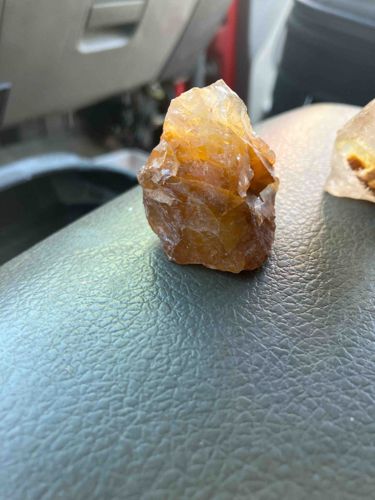
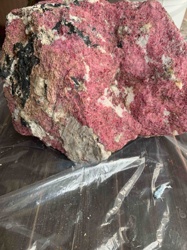
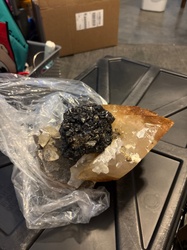
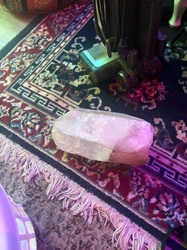
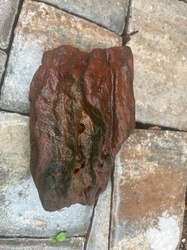
The item is a raw, unpolished crystal specimen, most likely Citrine, characterized by its warm, earthy tones ranging from translucent golden yellow to a rich, reddish-brown or amber hue. The crystal exhibits a natural, irregular shape with multiple facets and cleavage planes, characteristic of a rough mineral formation. Its physical dimensions appear to be small, likely fitting within the palm of a hand, though exact size cannot be determined without a scale reference. The surface is uneven and unrefined, showcasing both smoother, more crystalline faces and rougher, fractured areas. Some portions exhibit a higher degree of translucency, allowing light to pass through, highlighting internal inclusions or variations in color density. Other areas are more opaque or milky. There are no visible signs of cutting, polishing, or artificial shaping, indicating it is an untouched, natural crystal formation. The specimen appears largely intact with no obvious chips, cracks, or damage beyond its natural growth patterns. Its condition is consistent with a naturally occurring mineral fragment. There are no discernible maker's marks, signatures, or stamps, as is typical for raw mineral specimens. The absence of such markings further supports its natural origin. Based on its visual characteristics, this piece is a natural geological formation, likely formed over geological timeframes. The overall quality suggests a specimen valued for its natural beauty and metaphysical properties, rather than for gemological cutting or jewelry application.
AI Appraisal Report
Upon my virtual examination of the provided image, this raw crystal specimen presents as a natural, unpolished piece, consistent with Citrine due to its warm golden-yellow to reddish-brown hues and characteristic irregular crystal structure. The condition appears excellent for a natural specimen, showing no signs of artificial damage, chips, or cracks beyond its intrinsic growth patterns. Its authenticity as a natural mineral formation seems high based on visual characteristics; it clearly lacks any cut, polish, or artificial shaping. However, a significant limitation of authenticating Citrine from images alone is the common presence of heat-treated Amethyst, which can visually mimic natural Citrine. Without physical inspection, detailed scientific testing (such as Raman spectroscopy or refractive index measurement), or provenance documentation (e.g., mine origin paperwork), I cannot definitively confirm if this is natural Citrine or heat-treated material. Natural, untreated Citrine is rarer and commands a higher price. Market conditions for raw crystals like this are robust, especially for those interested in metaphysical properties or natural decor. Comparables for natural Citrine specimens of this apparent small size and quality typically range from $25 to $75, while heat-treated Amethyst may fetch $10 to $30. The lack of inclusions or exceptional clarity suggests it is not a high-gem-grade specimen suitable for cutting, but rather valued for its natural aesthetic. The absence of specific size references also impacts precise valuation. To confirm authenticity as natural Citrine (and not heat-treated Amethyst), I would require an in-person examination to assess specific crystal habits, color zoning, and potentially perform hardness tests. Provenance information would also be highly beneficial.